Follow Us on Google
• Says King’s College, Unity Schools are dungeon of stench, darkness
From Fred Itua and Fred Ezeh, Abuja
Amid protests over the concession of King’s College, Lagos, to its Old Boys’ Association, Minister of Education, Dr. Tunji Alausa, has defended the Federal Government’s decision, painting a grim picture of a school system he said had degenerated into dungeons of stench, darkness and decay unfit for training Nigeria’s future leaders.
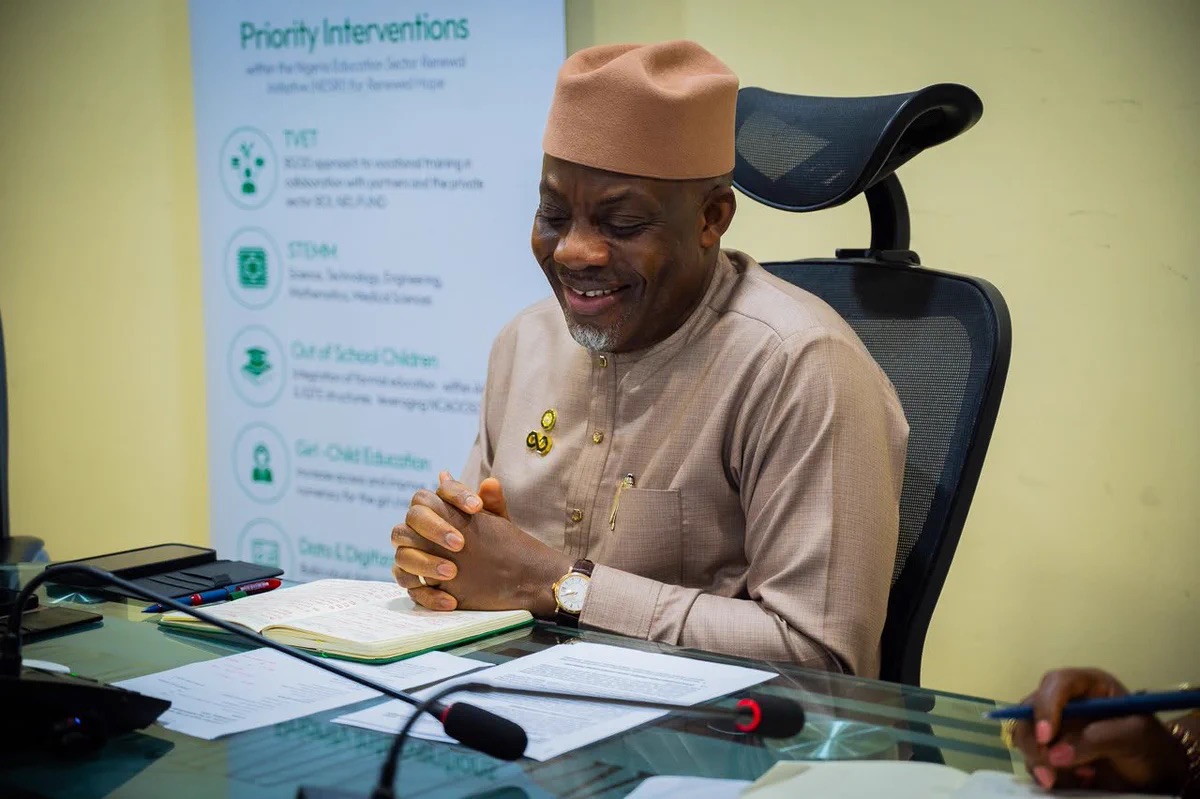
Alausa, who spoke when he received a management team of The Sun Publishing Limited, led by its Managing Director/Editor-in-Chief, Onuoha Ukeh, said conditions at King’s College and some other Federal Unity Colleges had deteriorated to unacceptable levels and required urgent intervention.
Recalling a visit to King’s College about a year ago, the minister said he was moved to tears by what he saw — filthy hostels and classrooms, unusable bathrooms, inadequate infrastructure and prolonged power outage.
“The hostels reeked of stench. Bathrooms were unclean. Dormitories looked like dungeons. The cafeteria resembled a place where slaves were fed. The school had no electricity for nine months,” Alausa said.
According to him, conditions in the classrooms and laboratories were equally disturbing.
“Classrooms had heaps of garbage. The science laboratory was in darkness. Students could not see the writing on the board. I asked a teacher how learning was possible in such conditions. The teacher had no answer,” he said.
Alausa said the experience, coupled with reports from other Unity Schools, convinced him that urgent action was required to halt the deterioration.
The Federal Government’s decision to concession the management of the 117-year-old King’s College to the King’s College Old Boys’ Association (KCOBA) under a Public-Private Partnership arrangement has triggered protests by workers and parents and disrupted activities in Federal Unity Colleges. The government has maintained that the school has neither been sold nor privatised and that it retains ownership and regulatory oversight.
Alausa said consultations with the Old Boys’ Association resulted in an arrangement under which the alumni would deploy their resources to rehabilitate, modernise and manage the institution.
“The King’s College Old Boys’ Association has offered to step in, take over management of the institution and invest its own resources into its full restoration.
“The alumni have pledged that the arrangement will involve no fee increases and that the school will continue admitting pupils from all regions of Nigeria,” he said.
The minister insisted that the arrangement did not amount to privatisation, saying the Federal Government would retain ownership while the interests of workers would be protected.
“About 57 of the 120 academic staff are Federal Government employees, while the rest are PTA staff. Everyone will be accommodated,” he said.
Alausa also questioned whether the Unity School system could continue to operate exactly as originally conceived, arguing that the circumstances that informed its establishment decades ago had changed considerably.
“Decades ago, parents could safely send their children to schools in distant states, but modern security concerns have rendered that practice impossible. Consequently, while private schools are expanding rapidly, government-owned Unity Schools continue to suffer from decades of severe neglect,” he said.
The minister expressed concern over opposition from some Parent-Teacher Associations (PTAs) to the reform programme, alleging that some had become involved in practices requiring investigation.
Other News
He alleged that some PTAs sell admission slots for as much as N20 million at a time some teachers earn about N60,000 monthly.
“In Unity Schools, pupils are left unsupervised, and some are involved in drug abuse,” he alleged.
Alausa further claimed that some PTAs had engaged a Senior Advocate of Nigeria (SAN), whose legal fees ranged between N100 million and N150 million, to challenge the reform.
“Where does a PTA get such money if not from criminal enterprises? Some of these groups even hire protesters to block reforms,” he alleged.
The minister said the Federal Government lacked the resources to undertake at once the extensive rehabilitation required across the Unity Schools, estimating that even N1 trillion would be inadequate to address the infrastructure deficit nationwide.
According to him, rehabilitating Unity Schools in Lagos alone would require about N24 billion, while those across the South-West would need nearly N40 billion.
Given the financial constraints, Alausa said partnerships with willing alumni associations offered a practical way of mobilising additional resources to restore deteriorating institutions.
He added that although the management model was being introduced at King’s College, it could eventually be extended to other Unity Schools, depending on the outcome of the arrangement and the willingness of alumni associations to support the rehabilitation of their former schools.
Beyond the controversy over King’s College, the minister said the government was recording progress under the Nigeria Education Sector Renewal Initiative, anchored on six pillars — technical and vocational education, Science, Technology, Engineering and Mathematics (STEM), reintegration of out-of-school children, expansion of girl-child education, data integration and digitalisation, and quality assurance.
He said more than one million out-of-school children had returned to classrooms, while over 250,000 young Nigerians were receiving training across 1,200 skills centres, with Federal Technical Colleges offering free tuition.
Alausa said enrolment in nursing education had risen from about 28,000 to approximately 130,000, while medical school intake increased from 5,000 to 12,000.
Under the World Bank-supported AGILE programme, he said more than six million girls had been enrolled in school.
The minister also said Nigeria had developed what he described as Africa’s largest education database, enabling the government to track children from primary through senior secondary education.
He said the data had, however, exposed a major problem in the transition from primary to secondary education, with between 22 million and 28 million children at primary level dropping to about 12 million at junior secondary level.
“This 18-million-child deficit is primarily caused by a severe shortage of secondary school facilities. Across the country, there are approximately 78,000 public primary schools but only 18,000 junior secondary schools,” he said.
Alausa said state and local governments, which he said receive 62 per cent of net federal revenues, also had a responsibility to expand secondary education infrastructure.
He urged journalists to interrogate the available education data and hold subnational governments accountable for deficiencies in school infrastructure.