Follow Us on Google
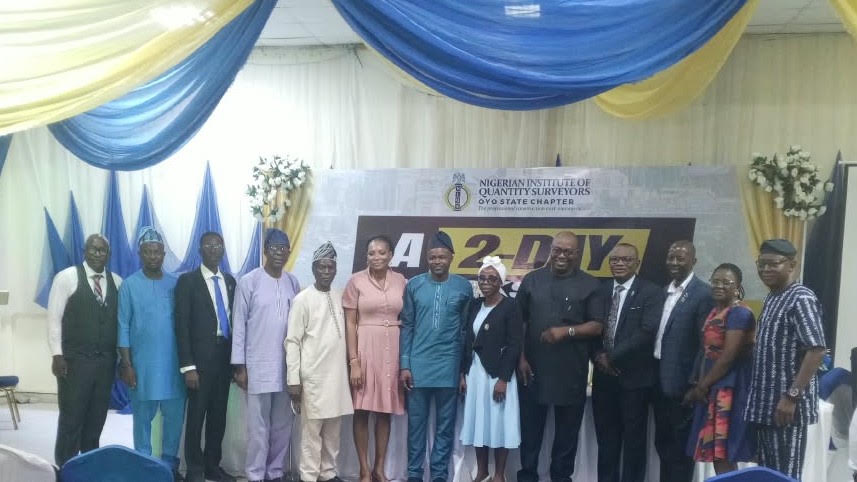
The Nigerian Institute of Quantity Surveyors (NIQS), Oyo State Chapter, has warned that artificial intelligence, rising inflation and exchange-rate volatility are rapidly changing the traditional practice of quantity surveying, urging professionals to reinvent their roles to remain relevant.
The institute gave the warning on Wednesday at its two-day workshop held at the University of Ibadan Conference Hall, Ibadan, Oyo State, with the theme, “Reimagining Quantity Surveying: Delivering Greater Value in a New Economic Reality”.
The workshop, which commenced on October 7 and ends on October 8, brought together quantity surveyors and other professionals in the built environment to examine emerging economic and technological challenges confronting the construction industry.
Speaking at the event, the guest lecturer, Dr Betty Oluwafunso Olojede, of the Department of Quantity Surveying, Obafemi Awolowo University, Ile-Ife, said the profession could no longer rely on conventional methods of cost estimation as technology continued to provide clients with faster access to construction cost information.
Olojede challenged quantity surveyors to demonstrate the additional value they bring to clients beyond estimates generated by digital applications.
She asked professionals to consider what they could offer when “an app can estimate my building cost in a few minutes”, stressing that the future of the profession would depend on the ability of quantity surveyors to provide evidence-based advice, risk analysis, option appraisal and strategic cost management.
According to her, the changing economic environment requires quantity surveyors to understand whole-life value, rather than concentrating only on the initial cost of a project.
She identified inflation, currency volatility, supply-chain challenges, sustainability requirements and technological advancement as some of the major forces reshaping decisions in the construction industry.
Olojede warned that static and manual preparation of bills of quantities, which could take weeks, was increasingly unsuitable in an environment where construction prices could change significantly within a short period.
She also criticised fixed-pricing approaches that failed to adequately address currency and inflation risks, saying such practices could damage clients’ confidence.
The lecturer urged quantity surveyors to incorporate price-adjustment and fluctuation provisions into contracts, identify foreign-exchange-exposed materials and equipment separately in cost plans, and provide clients with regular cost-risk updates.
She further encouraged professionals to embrace digital tools and artificial intelligence while maintaining responsibility for checking the accuracy of information generated by such systems.
“AI: responsibility stays with the professional,” she emphasised, urging quantity surveyors to verify quantities, arithmetic, rates, references, contract provisions and scope before issuing professional advice.
Olojede also identified opportunities for professionals to diversify their services into cost health checks, bid reviews, contract risk audits, claims preparation, lifecycle cost advice, public-private partnership cost inputs and dispute-related services.
Earlier, the chairperson of the NIQS Oyo State Chapter, Abass Adelayo, said the theme of the workshop was informed by the need for quantity surveyors to respond to the realities of the Nigerian economy.
Adelayo said quantity surveyors could no longer limit their responsibilities to project costing but must develop the capacity to become value creators and strategic advisers.
Other News
She cited the example of a three-bedroom duplex whose construction cost was estimated at about N25 million in 2022, but which had risen to approximately N89 million when reassessed at prevailing rates.
She said the development demonstrated the impact of inflation and rising material costs on construction projects.
According to her, the situation requires quantity surveyors to understand economic trends and help clients make realistic and sustainable decisions.
Adelayo also narrated the case of a client who approached a quantity surveyor to design and cost a greenhouse within a N50 million budget.
She said while the first approach produced a cost above the client’s budget, another quantity surveyor sought to understand the client’s underlying objective rather than focusing solely on the original specification.
The second QS subsequently proposed a phased development involving two two-bedroom apartments at about N40 million, with a strategy for income generation before the second phase.
Adelayo said the example demonstrated the need for quantity surveyors to move from simply answering the question of “how much will it cost?” to determining what value can be delivered within the client’s resources.
She urged members to embrace continuous learning, saying professionals must be prepared to “learn, unlearn and relearn” in response to technological and economic changes.
Also speaking, the special guest of honour, Oyo State Commissioner for Public Works, Infrastructure and Transport, Hon. Abdulmojeed Olawale Mogbonjubola, said quantity surveying was about more than estimating costs, describing it as a profession focused on ensuring value for money.
Mogbonjubola said accurate cost estimates could improve productivity, promote economic activity and support better decision-making on projects.
He noted that Oyo State’s urban expansion and increasing demand for housing, transportation infrastructure, educational facilities, healthcare projects and commercial developments had further increased the importance of quantity surveyors.
The commissioner urged the institute to continue investing in professional development, mentorship, research and digital technology.
He specifically encouraged younger quantity surveyors to develop competence in modern tools and platforms, including Building Information Modelling (BIM) and quantity surveying software.
The immediate past chairman of the NIQS Oyo State Chapter, Mr Oluwade Kolawole, said the workshop was designed to strengthen the capacity of members to respond to technological and economic changes.
Kolawole said the rising cost of construction materials and labour had made it necessary for professionals to rethink how they provide cost advice to clients.
He said the workshop would help participants understand emerging technologies and develop strategies for ensuring that clients continue to obtain value despite prevailing economic pressures.