Follow Us on Google
By Chinyere Anyanwu, [email protected]
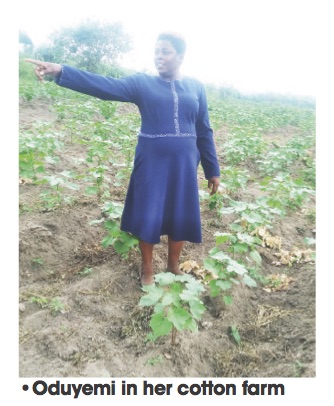
Helen Omowunmi Oduyemi, is the Chief Executive Officer of Helogenous Agro Products Limited and a 2012 graduate of Science Laboratory Technology (SLT) from Ladoke Akintola University, Ogbomosho, Oyo State. She has ventured into different aspects of agriculture. In 2016 , she started Helogenous Global Services, which was upgraded to Helogenous Agro Products Limited in 2018. Her major current effort in agriculture is in the cotton value chain. In this interview with Daily Sun, Oduyemi spoke on cluster farming, reviving Nigeria’s textile industry through improved cotton production, effects of herdsmen attacks on agribusiness, government intervention, among other issues.
Excerpts:
Area of expertise in agriculture
We are into different areas of agriculture; we do agro-processing for export, we do plant production and presently we are working on cotton and potatoes. For the cotton, we have an arrangement of cluster farming. That is why we are encouraging people to come into the concept of cluster farming where a group of people can come together and that’s why we now have Helogenous Multipurpose Farmers Cooperative, which is registered with the government. And under that we have more farmers, more collaborators, to plant and to meet the demand of buyers. In the cooperative, all the farmers have their individual farms but under the cluster project, everyone plants cotton for now.
Off-takers
Helogenous Agro Products Limited serves as the off-taking company where we have a Memorandum of Understanding (MoU) with our buyers. So we off-take from the cluster, that means from the cooperative, and the company buys from us. The company also trains the farmers, then we help in sourcing the right inputs for them. For example, in 2019 when we started this cotton project, we found out that the cluster we had then was not profitable because the specie of cotton seed we got wasn’t too good. It was the same with other farms across the country; in fact, most farmers got into debts that period but because we started with our own money, and didn’t owe CBN. So because the project was not profitable at that time, we started researching into how to get improved seed. Our work at Helogenous Agro Products Limited, in our bid to support the cluster farms, is to keep researching, then do demonstrations on whatever size of land we want to cultivate and see if it will bring good yield. So now that we have an improved seed, last year we were able to get some profit from it. And we know that now other people can come into cotton farming and Africa can actually cloth itself.
From SLT to griculture
It started from observing; observing what the problem is in our country, Nigeria, and in Africa generally. We rely more on foreign help, foreign this and that and I feel that we don’t have a competitive advantage in our science and technology but if we deploy that knowledge to where we have competitive advantage, we’ll do well. From the knowledge of physics, mechanical engineering and other courses we learnt under Science Laboratory Technology, I was able to put together a solution that is applicable in farming. For example, developing improved seed, being able to document, all these things like methodology, research, that scientists do on a normal day, I am able to use that expertise to help more farmers to be profitable. And now we have advanced economics of production for different crops, cotton, potatoes, and people are really making profits when they follow the economics of production we are teaching them. We just try to bring science into agribusiness so that there can be profitability.
Second reason I diverted into agriculture is that I don’t want to just stay in the laboratory. I want to be on the field and I want to apply whatever I learnt in school because science laboratory is actually under Pure and Applied Sciences, so it’s a knowledge you have to apply. That’s one of the reasons I veered into agriculture. Agriculture is a solution. That is where Nigeria has competitive advantage. When it comes to global competitiveness, we have the advantage of having land, favourable weather, human resources, among others. So, if we can deploy the knowledge we have into agriculture, we will be able to compete favourably.
I’m a third generational farmer because my grandparents are farmers. I grew up in a village in Osun State, Esaoke, to be precise. Ive always been in an agrarian community and I understand the pains of farmers. I know where the money is in agriculture just by observing. It’s just a privilege that I can combine local intelligence with science.
Reviving textile industry through cotton farming
I see our efforts in cotton farming bringing back life to the textile industry because what we are doing presently has started generating some results. We are already having invites from the Oyo State government where we started the pilot project. Since 2019 we have been on it in Oyo State and now we can say that Oyo State can expand what we have been able to do. We did a trial project of 25 hectares this year (I don’t really run my own private farm. I do agro-processing apart from training the farmers, sourcing the land for them, getting them all they need, sourcing for inputs, the right machinery they need, and aggregating it. We get the land, cleared it and then the farmers come in under the cooperative society and we train them and they are able to execute the project). We are partnering with a T-shirt producing company already and we also have another company in Ogun State we are partnering with. We have done a demo of two hectares there just to see how it will turn out. We’ve also done in Osun State but the major farm is in Oyo State. We just want to see how we can scale it up.
I see these efforts solving a lot of problems in Nigeria because at this small scale we have about 13 villagers working as labourers on the farm and in terms of technological advancement, we’ve been able to fabricate a small machine that plants the cotton seed with the help of a technician because we couldn’t find one in the market. If Nigerians know that this model is already on ground, and that there are a lot of farmers who need that implement, they won’t be afraid to go into mass production. And that is money from one side, the side of mechanical advancement for the country. Then for textile, the company is going to be selling locally and exporting the T-shirts. The T-shirt producing company have seen that there’s a gap; they don’t have enough input (cotton) and I told them that if they are interested, we will do backward integration for them where we will use the cluster farm to produce enough input for them.
And now we are looking at venturing into ginnery in South West Nigeria because I can categorically say that there is no place in the region where you can take the raw cotton to separate the seeds and the chaff from the lint and then turn it to yarn. We are looking at establishing a small size and that will really transform the economy of the South West because one cotton farm employs nothing less than 10 people in the rural community. That will stop rural/urban migration and that is one of my dreams. I also know it’s going to transform the textile industry and it has started because we are not selling the end product outside the country; we are selling to a T-shirt producing company based in Nigeria. So, that on its own is creating employment along the value chain – for the people producing the T-shirts, for those dying the yarn and the people processing from the farm. I see it transforming our economy.
Agro-processing
Presently we do potato flour. We do garri. We do basically food and now we are going into cotton processing. Before now we were milling cotton oil from the cotton seeds we produce, and it is a very healthy edible oil and is also used in the cosmetics industry because it’s very good for the skin. We have the cosmetic arm of the business, Sherlocks Limited, where we add value to agro produce for beauty therapy.
Presently, we have our cluster farmers who grow orange fleshed sweet potatoes (OFSPs) for us and the purple potatoes, which we process into flour. These are potatoes that are high in nutrient and vitamins. We turn the white potatoes into pillets, which are for exports.
We also off-take cassava from our private farmers who grow cassava and process that to cassava chips whenever we have export order for such. We are creating market for them while they are creating raw materials for us.
Challenges
When we did potatoes, we had challenge of herdsmen destroying our over N20 million farm but this year when they saw that we are planting cotton, they left because their cows cannot eat cotton. When such damages happen to our farms and we call the people in the community to follow us to the police station as witnesses, they will refuse and their reason is that they don’t want the herdsmen to carry out reprisal attacks on them.
Though one of the herdsmen actually sent some people to beg me but the issue is that I’ve not fully recovered from that incident. I’ve been paying back debts to the people who invested with me in that project.
That slowed down our OFSP project and it was a big setback because we already bought a hydrator, the grating machine and we had already signed with some companies in Russia to be supplying them the processed OFSP and with the ongoing war, it would been a major breakthrough for Nigeria. It would have been earning us some foreign exchange. They were uprooting our potatoes and eating them raw as well as their cows, and also putting them into their sacks to take home. I was not told, I saw them myself. It was not one day, it was not two days; it was a continuous thing and I did not have the strength to face them by myself; I did not have enough security. At a time I had to stop my boys who were trying to keep them at bay. They kept at it until one day we came to the farm and discover they had destroyed everything. So we stopped that project and that was at the point I embraced cluster farming fully. Now they know I’m not the only one involved and they cannot attack everybody in the cluster. Secondly, their cows cannot eat cotton.
We are trying to get the support of the state government to get a more secured land where we won’t have Omonile problem. That’s another challenge. For instance, you can get a land, bulldoze it, clear and plant and the villagers will come and tell you to vacate their land because there’s a family member who came from Lagos or abroad and wants to use the land and if you don’t, they will just tractorise what you planted there and that will be the end of the business. We’ve been having that challenge over and over, and now we are talking with the Oyo State government and they are supportive; they have listening ears. They saw us at a programme and said, ‘these youths are trying, come let’s discuss’. They told us where to go and check land and we saw that they were already bulldozing the land and we were excited and we decided we would go back to do more with their support.
The challenge has been trying to do everything from the scratch – bootstrapping, looking for the fund; it’s not been easy but if you believe in something, you will give it your all. With prayers, it will work out. It’s been challenging – from harvesting, trying to sell the potatoes raw, Nigerians don’t eat OFSP as we thought they would but people are now more aware of organic foods that you don’t need to use harmful chemicals that destroy the soil. We use organic fertilisers, organic manure to boost your production.
Government intervention
I will encourage government to be more sincere with their projects. There are lots of projects going on. They will say government is sponsoring 1,000 women in this and that project, government has made this and that facility available but when you try to apply for these projects, it’s another story. You don’t even see someone to interface with. The only support I’ve seen that people were able to apply for and get something was the Nigeria Export Promotion Council (NEPC) grant, which was done in 2021. People got the grant without lobbying for it. If that kind of process is implemented in agriculture where people can go online, apply and present evidence of what they have done and get the support they need without stress, that will go a long way in encouraging more entrants into the sector.
So I advise that government should try to see that whatever support they are offering to the farmers are actually reaching the end users, the people who really need it. If they do this, they can be trusted. I can say that those of us in export business trust the NEPC because they are sincere with us; they gave us grant, they train us, they are interested in what we do, they come to inspect our factories, and they are trying to help us to get access to market outside the country because we told them that is a challenge to us. I believe that if sincere people are in the right positions, things get better.