Follow Us on Google
Celebrated academic and historian, Professor Toyin Falola, has urged African universities to embrace a transformative approach to knowledge, calling for the integration of indigenous wisdom, modern scientific innovation, and ethical frameworks as essential to safeguarding the continent’s intellectual future.
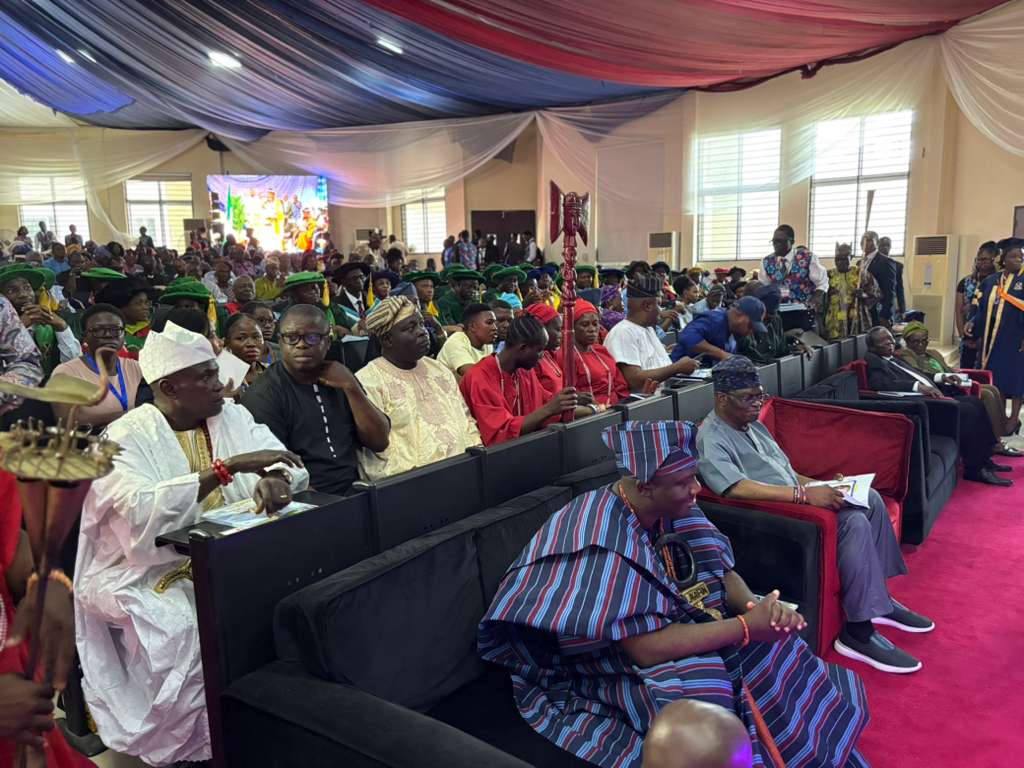
Falola made this appeal on Thursday during the 17th Convocation Lecture of Ajayi Crowther University, Oyo. The lecture, titled “The Future of Knowledge”, was held at the Modupe and Folorunso Alakija Faculty of Law Auditorium and formed one of the highlights of the institution’s convocation ceremonies, drawing academics, students, policymakers, and members of the wider public.
Addressing the audience, Falola highlighted the enduring legacy of colonialism on African higher education, noting that postcolonial institutions continue to mirror Western epistemic frameworks. “The first generation of higher institutions in Africa was established by the colonial bureaucracy, rooted in Western epistemology and devoid of indigenous ideology. This character was maintained even in the postcolonial era, as evidenced by the creation of an elite class well-disconnected from Africa’s realities and developmental priorities,” he said.
He stressed that Africa must break away from this epistemic dominance by adopting a pluriversal mode of knowledge, where indigenous and Western epistemologies coexist. “Africa can be intellectually free if it breaks away from the epistemic dominance of the West and adopts a pluriversal mode of knowledge, where indigenous knowledge can be integrated with Western knowledge.
The security of Africa’s intellectual future lies in how its tertiary institutions can combine indigenous ideologies with modern science, with a vision of achieving genuine epistemic and intellectual freedom,” Falola emphasized.
Falola warned that the explosion of data in the digital era has not necessarily resulted in increased understanding or wisdom.
“The future of knowledge must go beyond the accumulation of data and the exchange of information. The twenty-first century presents the world with a contradiction: the world is gradually being inundated with information while it continues to thirst for understanding.
The digital revolution has helped the world evolve into a data mine where algorithms can quantify human experience and technology can adapt human emotions, histories, and memories into patterns. The abundance of information, however, has not resulted in the illumination of wisdom. Therefore, we are responsible for transforming vast amounts of information into meaningful insights,” he said.
The scholar further emphasized that knowledge without an ethical foundation can become destructive. “When knowledge is not embedded in ethics, spirituality, and communal values, it can become destructive. In the present era, data is celebrated as a form of power. However, we need to understand that power must serve humanity and not dominate it. The approach of a community embedded in wisdom, therefore, refers to the integration of science, philosophy, art, and spirituality as a synthesis that restores the moral and metaphysical foundations of knowledge,” Falola stated.
Emphasising the critical role of wisdom in the technological age, Falola noted, “A wise civilization will not reject technology; it will instead seek to humanize it. African knowledge systems are deeply rooted in the ethics necessary for humanization; therefore, integrating them with technology can help achieve the essence of wisdom, as the principles of ethics, equity, and collective memory will guide the development of technology. There must be just governance of knowledge in this era to ensure that access to knowledge is universally available.”
Falola also addressed the transformative potential—and accompanying risks—of Artificial Intelligence (AI). “Artificial intelligence provides a novel threshold for the co-creation of knowledge by humans and machines. This system enhances efficiency but puts Africa at risk of epistemic dependency. Therefore, it needs to be complemented by ethical frameworks,” he said.
He stressed that AI systems in Africa must reflect local contexts and ethical priorities. “African institutions must develop AI that is grounded, adaptive, relevant, and functionally appropriate to the foundations of the multivarious African indigenous geopolitics, knowledge, ethics, and languages,” he emphasized, warning that technology, if uncontextualized, could inadvertently perpetuate dependency on Western models.
The scholar called for universities to cultivate plural, decolonized, and humane knowledge ecosystems capable of guiding Africa through scientific, technological, and moral challenges. “The African knowledge system must create plural, decolonized, and humane ecosystems of co-creation for humanity. This is what the future should look like for African tertiary institutions,” he said.
Falola’s lecture underscored the importance of linking tradition with modernity and morality with innovation. According to him, “For knowledge to survive in the Digital Age, there must be a synergy between innovation and ethics. African knowledge embodies features of spirituality, morality, and creativity; therefore, it should provide guidance for scientific innovations that benefit the collective good of humanity.”
The lecture drew a wide audience of scholars, students, policymakers, and members of the public, all eager to engage with Falola’s vision for a decolonized, ethical, and technologically empowered African knowledge system.