Follow Us on Google
By Steve Agbota
African Customs administrations have committed to eliminating multiple checkpoints and disparate transit fees within the region.
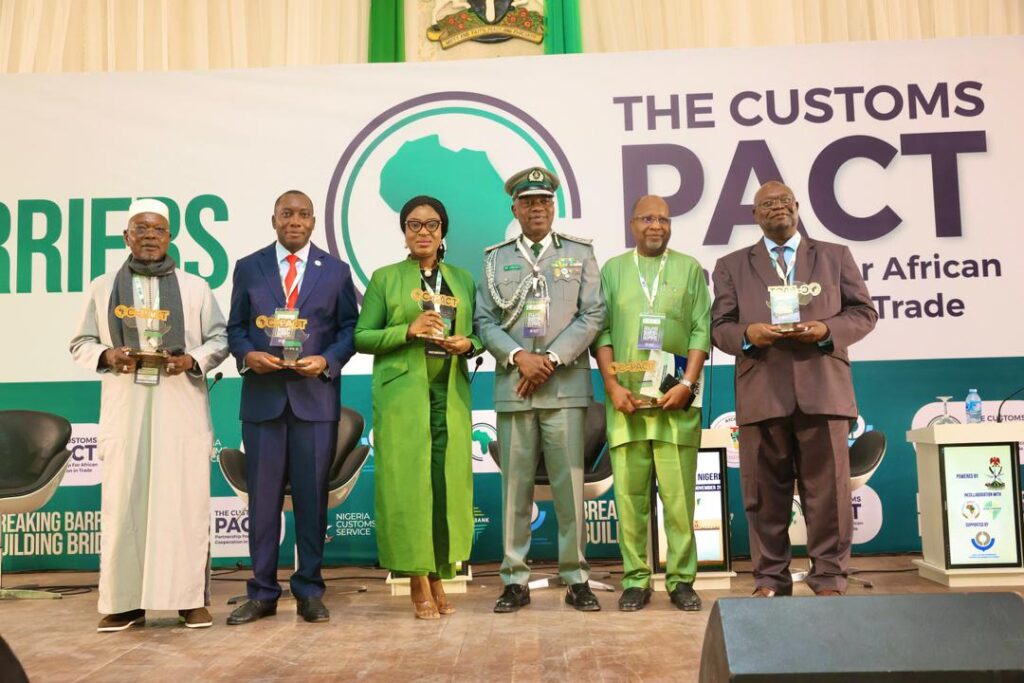
The administrations made the commitment at the Customs Partnership for African Cooperation in Trade (C-PACT) conference, themed “Breaking Barriers, Building Bridges”, in Abuja.
This was contained in the conference report, presented at the event’s closing by the Chairman of the Organising Committee, Deputy Comptroller-General (DCG) of Customs, Dera Nnadi, in Abuja.
The C-PACT was convened by the Nigeria Customs Service and Afreximbank, with support from the World Customs Organisation (WCO).
Nnadi, who is also the DCG in charge of Strategic Research and Policy at the NCS, said they resolved to address key challenges affecting trade facilitation in the region, including improving transport infrastructure, enhancing border security, and strengthening customs system interconnectivity alongside cybersecurity.
He said they committed to harmonising national policies and procedures in line with African Continental Free Trade Area (AfCFTA) frameworks aimed at easing trade within the region.
The administrations, he added, resolved to adopt best practices such as the E-Certificate of Origin and Single Regional Bond.
Nnadi said the bodies committed to enhancing Customs–Private Sector Partnerships by fostering collaborative relationships and driving mutual solutions for trade facilitation.
This, he said, was alongside addressing soft infrastructure gaps through prioritising digitisation, harmonisation, and modernisation of customs procedures and border infrastructure.
The administrations, he added, pledged to implement trade facilitation measures such as multilingual customs documents, global commerce facilitation, holistic border facilities, and competency-based leadership.
Other News
Nnadi said the Customs administrations had also resolved to accelerate AfCFTA implementation by adopting regional Authorised Economic Operator and Mutual Recognition Agreement frameworks, enhancing data sharing, and building trust among regional blocs while urging cooperation among stakeholders.
According to him, the Customs administrations will leverage WCO expertise and Afreximbank support for capacity building and infrastructural development.
“Let us work together to harmonise policies and procedures, enhance Customs–Private Sector Partnership, address soft infrastructure gaps, accelerate AfCFTA implementation, and drive economic growth, job creation, and prosperity for all Africans.
“As we conclude Customs PACT 2025, it is resolved that we reaffirm our commitment to a prosperous Africa built on the pillars of collaboration, innovation, and inclusivity. “Let us harness the momentum of the conference to drive meaningful change, break barriers, and build bridges towards a borderless and prosperous Africa,” he said.
Elaborating on the report, the NCS’s Comptroller-General, Bashir Adeniyi, stated that the administrations had reached an agreement on the next steps to implement the conference resolutions, including the institutionalisation of C-PACT.
“There is a general consensus, as we have proposed, that in terms of positioning, we are going to submit a proposal to collapse C-PACT under the Committee of Heads of Customs structure of the AfCFTA agreement.
“So, in terms of governance structure, that is the structure under which we are going to be addressing issues related to C-PACT.
“In terms of the technical part, we agreed that the tools and instruments developed by Afreximbank will serve as starting points for implementation.
“There are specific plans to bring C-PACT under the current structure of the Intra African Trade Fair (IATF), which has been running, so that during every session of the IATF, we will dedicate sessions to C-PACT, which has already been documented,” Adeniyi said.
The Comptroller-General said that teams from the AfCFTA Secretariat, NCS, and Afreximbank would review the report before submitting it to the relevant structures for appropriate action.