Follow Us on Google

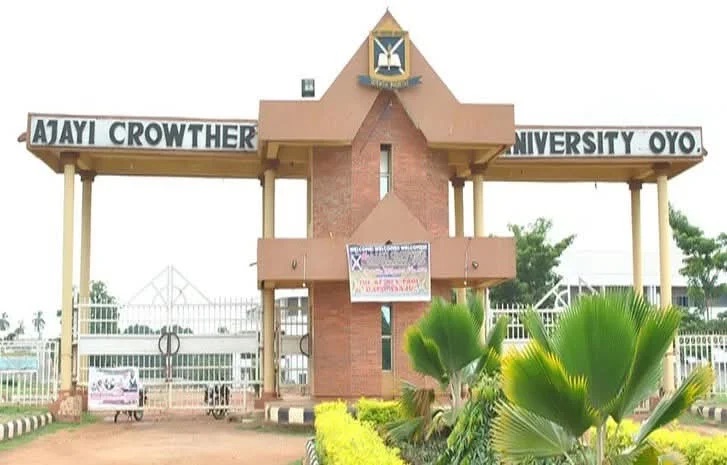
Ajayi Crowther University (ACU), Oyo, has rewarded its three best graduating students with N10 million in cash prizes at its 18th convocation ceremony, just as it renewed calls on the Federal Government to extend the interventions of the Tertiary Education Trust Fund (TETFund) and the Nigerian Education Loan Fund (NELFUND) to private universities and their students.
The overall best graduating student, Elizabeth Ayomide Obarotimi, of the Department of Industrial Chemistry, Faculty of Natural Sciences, received N5 million for recording a cumulative grade point average (CGPA) of 4.91 out of 5.0.
The second-best graduating student, Olufunmilayo Adesewa Owoeye, of the Department of Economics, Faculty of Social Sciences, received N3 million for her 4.88 CGPA, while Opeyemi Joy Oloyede, of the Department of Radiography and Radiation Science, Faculty of Basic Medical Sciences, received N2 million for graduating with a CGPA of 4.86.
Presenting the prizes on Wednesday, Pro-Chancellor and Chairman of the Governing Council, Olutoyin Okeowo, announced that the university would double the cash rewards next year, urging students to remain committed to academic excellence and uphold high moral standards.
He charged the graduates to deploy their knowledge and skills towards addressing societal challenges and distinguishing themselves in their chosen professions.
“I urge you to distinguish yourselves wherever you find yourself. Be problem-solvers; be the heroes and heroines of your generation. Uphold discipline, make wise choices and strive for excellence in all your endeavours,” he said.
Apart from the N5 million cash reward, Obarotimi won eight other academic prizes, including those for the overall best graduating student, best female graduating student, best graduating student in the Faculty of Natural Sciences and best graduating student in the Department of Chemistry.
Vice-Chancellor of the university, Prof. Ebunoluwa Oduwole, had, at a pre-convocation press conference, disclosed that 4,104 graduands would receive various academic qualifications, including 116 first-class degrees, 1,207 second-class upper division, 693 second-class lower division and 45 third-class degrees.
At the postgraduate level, she said 158 graduates would receive postgraduate diplomas, 1,798 master’s degrees and 87 doctorate degrees.
Oduwole, who is also Alternate Chairman of the Committee of Vice-Chancellors of Private Universities in Nigeria, faulted the exclusion of private universities and their students from TETFund interventions and the Federal Government’s interest-free education loan scheme, arguing that access to public educational support should be determined by students’ needs rather than the ownership of their institutions.
She disclosed that the committee, chaired by the Vice-Chancellor of Nile University, Prof. Dilli Dogo, was engaging the Federal Ministry of Education, the National Assembly and the managements of TETFund and NELFUND to secure amendments to the relevant laws.
Oduwole argued that TETFund, which derives its funding from taxes paid by companies operating in Nigeria, should support both public and private tertiary institutions in infrastructure development, research funding, provision of teaching and learning equipment, and staff training.
“Private universities are also Nigerian institutions, training Nigerian students for national development. Excluding them from TETFund undermines the overall goal of raising standards across the entire tertiary education sector,” she said.
On the student loan scheme, the vice-chancellor maintained that restricting beneficiaries to public tertiary institutions was unfair to students in private universities, some of whom came from low-income families and struggled to meet their financial obligations.
“The Federal Government support for education should be about the Nigerian students, not about the ownership of institutions. A Nigerian student in a private university is as Nigerian as one in a public university,” she said.
Oduwole also disclosed that the National Universities Commission (NUC) had approved new academic programmes for the university’s 2026/2027 academic session, including Medicine, Pharmacy, Anatomy, Physiology, Pharmacology, Public Health and Artificial Intelligence, while the Council of Legal Education had increased its Law admission quota from 50 to 100 students.
She added that the pro-chancellor had committed N400 million to infrastructure development, with projects scheduled for inauguration during the convocation, including 16 self-contained staff quarters and a 64-bed female hostel extension at the Ajegunle campus.
Meanwhile, Chairman of the Supra-Diocesan Board (West) of the Church of Nigeria (Anglican Communion), Archbishop of Lagos Province and Bishop of Remo Diocese, Michael Olusina Fape, called for increased employment opportunities for graduates of Nigerian universities, lamenting the shrinking opportunities and resources available to young people entering the labour market.
Fape appealed to individuals and organisations in positions of influence to assist young graduates in securing employment and realising their potential.
Delivering her valedictory speech, Obarotimi attributed the achievements of the graduating students to the collective sacrifices of their parents, guardians, lecturers and other members of the university community.
Quoting a Yoruba proverb, “Eni kan ni o bimo, opo eniyan ni o to,” meaning that one person gives birth to a child but many people help raise the child, she acknowledged the contributions of those who supported their academic journey.
“We have faced numerous trials and encountered hurdles, and we came out stronger and wiser. We showed up, and because of that, we are graduating today. We have made it through this,” she said.
Obarotimi urged her fellow graduates to confront the future with courage and deploy their knowledge towards making meaningful contributions to society.