Follow Us on Google

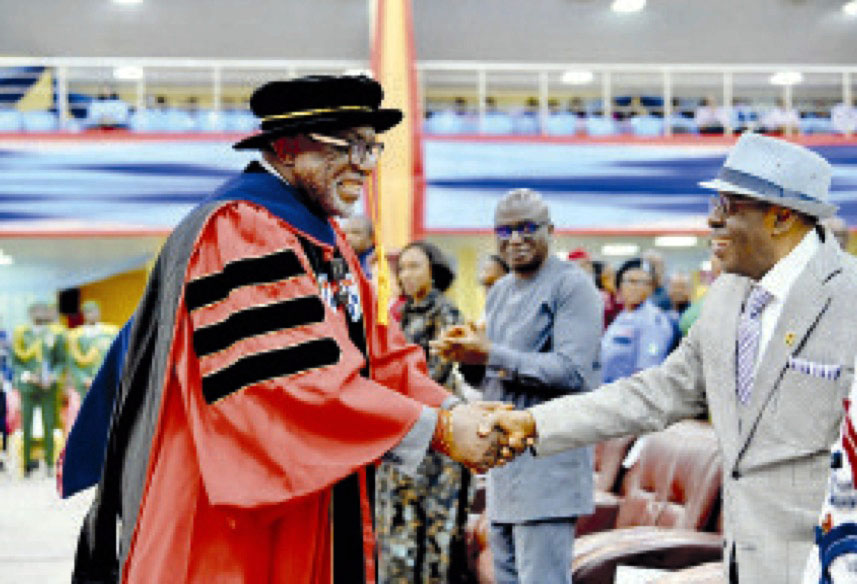
From Priscilla Ediare, Ado-Ekiti
Founder of Afe Babalola University, Ado-Ekiti (ABUAD), Afe Babalola, and former Executive Secretary of the National Universities Commission (NUC), Peter Okebukola, have endorsed a proposed overhaul of Nigeria’s educational system, following a call by the Executive Chairman of United Nigeria Airlines, Obiora Okonkwo, for universities to prioritise practical skills, entrepreneurship and moral values over the mere acquisition of academic qualifications.
Babalola, who described Okonkwo’s presentation at the university’s 14th Convocation Lecture on Tuesday as one of the most brilliant he had heard, disclosed plans to forward copies to President Bola Tinubu, the Federal Ministry of Education and the NUC for consideration.
Okonkwo, who delivered the lecture at the institution’s Alfa Begore Hall, called for a fundamental shift towards functional education that combines academic knowledge, practical skills, entrepreneurship and sound moral values.
The lecture was titled “Functional Education and the Nigerian Project: Strategic Human Capital Development for National Renewal.”
He argued that Nigeria’s educational system must move beyond producing graduates with certificates to developing individuals capable of solving practical problems, creating employment, promoting innovation and contributing meaningfully to national development.
According to him, although functional education has remained a recurring theme in government policies, university programmes and employers’ demands, insufficient attention has been devoted to defining its purpose and determining the specific needs it should address.
“For decades, public discourse has repeatedly called for functional education. Governments advocate it. Universities proclaim it. Employers demand it. Yet, surprisingly, little attention has been paid to defining what functionality itself actually means. Functional for whom and for what purposes?” he asked.
Okonkwo explained that functional education should be assessed by its capacity to equip learners with relevant competencies, prepare them for the workplace, encourage entrepreneurship and enable them to contribute to the economic and social transformation of their communities.
He stressed that Nigeria’s development challenges required a deliberate alignment of educational curricula with the country’s economic priorities, technological advancement and labour market demands.
The convocation lecturer maintained that universities must evolve beyond their traditional roles as centres for transmitting theoretical knowledge and become institutions where students acquire practical experience, develop innovative ideas and create solutions to societal problems.
He identified agriculture, engineering, medicine, business, law and the sciences as fields in which educational institutions should strengthen practical training, research, multidisciplinary collaboration, international partnerships and entrepreneurship programmes.
According to him, Nigeria’s future depends significantly on its ability to develop human capital capable of responding to the demands of a rapidly changing global economy.
Beyond technical competence and professional expertise, Okonkwo emphasised the importance of character formation, describing moral values as indispensable to sustainable economic growth and national renewal.
He argued that a society could produce highly skilled professionals and accomplished entrepreneurs without achieving meaningful development if its institutions were weakened by corruption, dishonesty and a lack of accountability.
“Human capital without moral capital cannot sustain national development,” he declared.
Okonkwo said education should produce not only competent graduates but also trustworthy citizens, ethical professionals and responsible leaders whose decisions are guided by integrity and a commitment to the common good.
He identified integrity, discipline, patriotism, leadership, accountability, industry, compassion and humanity as essential values that tertiary institutions must deliberately cultivate in their students.
According to him, these values are not peripheral to economic development but provide an important foundation for building public trust, attracting investment, strengthening institutions and encouraging productive business relationships.
“Excellence without integrity is dangerous; competence without character is unstable; innovation without ethical restraint is destructive rather than transformative,” he said.
Okonkwo noted that investors were more likely to operate in environments where contracts were respected, institutions were trusted and ethical standards were upheld.
He added that scientific discoveries, technological innovations and entrepreneurial ventures could deliver sustainable benefits only when guided by responsibility, fairness and respect for human dignity.
Drawing on the works of scholars Francis Fukuyama and Douglass North, he explained that trust, institutional quality and the values underpinning social and economic relationships were critical to competitiveness and development.
He also invoked the philosophy of American civil rights leader Martin Luther King Jr., who emphasised the importance of combining intelligence with character in the pursuit of true education.
Other News
Okonkwo maintained that Nigeria’s educational challenge was not simply the need to produce more graduates but to ensure that they possessed the wisdom, conscience and sense of responsibility required to use their knowledge for the benefit of society.
He commended ABUAD for its commitment to connecting academic learning with practical application, innovation and entrepreneurship, noting that the institution had demonstrated an understanding that higher education should prepare students not only for salaried employment but also for professional practice, business ownership and value creation.
“From my findings, and I assure you, I have done extensive research on this institution well, ABUAD has, over the years, established a tradition of excellence in consistently turning out graduates who are not only employable, but are equipped to become innovators, entrepreneurs, professionals and creators of value,” he said.
He, however, urged the institution not to rest on its achievements, maintaining that universities must continuously review their programmes and strengthen partnerships with industry to ensure that graduates are adequately prepared for the modern workplace.
Addressing the graduating students, Okonkwo challenged them to become problem-solvers and job creators rather than depend solely on paid employment.
“Do not mistake your certificate for the education itself; let the true evidence of your education be found in what you do with the knowledge and opportunities you have received,” he said.
“Go into the world not merely as degree holders seeking employment, but as problem-solvers, creators, innovators, professionals, entrepreneurs and value-makers, asking not only, ‘Where can I find a job?’ but, more importantly, ‘What problem can I solve?’”
He urged them to pursue professional mastery, embrace technology and international standards, and remain committed to Nigeria’s development.
“Start small if necessary, respect the dignity of work, guard your integrity, and remember that competence without character is ultimately dangerous. Above all, become responsible citizens who contribute rather than merely complain, and measure your success not only by wealth or position but by the lives you improve, the problems you solve, the institutions you strengthen and the legacy you leave behind,” he said.
Okonkwo added: “Do not ask what the world owes you because you have graduated; ask what the world needs from you because you have been educated. Let your education become action, your knowledge become competence, your competence become value, your value become service and your service become a contribution to the transformation of your society.”
In his remarks, Babalola described Okonkwo as an accomplished entrepreneur whose leadership in the aviation industry offered valuable perspectives on the relationship between human capital development, enterprise and national progress.
He commended the lecture’s emphasis on reforming Nigeria’s educational system to meet present and future national requirements.
“When I was planning this university, many universities visited us to find out why we were ranked number one in Nigeria for five consecutive years, number two in Africa and number 54 in the world,” Babalola said.
The university founder, who disclosed that ABUAD had about 10,000 resident students, argued that educational institutions must anticipate future developments and equip learners with the knowledge and skills required to succeed in emerging industries.
“We cannot teach here what we are going to become in the future without considering the curriculum. There should be a curriculum that prepares university students for what they will become,” he said.
Babalola expressed concern over deficiencies in existing university curricula, stressing that educational programmes should reflect economic realities and the competencies required by employers and entrepreneurs.
He also criticised the proliferation of universities without adequate facilities and standards, calling for more rigorous scrutiny of institutions seeking approval to operate.
He recalled that NUC officials previously conducted physical inspections of university facilities and equipment before granting approval, suggesting that the regulatory process should continue to prioritise quality and institutional readiness.
Babalola disclosed that he would circulate copies of Okonkwo’s lecture to the NUC, the Federal Ministry of Education and President Tinubu for consideration, particularly regarding the need for educational reform.
“If you are properly educated, there are jobs that you can do despite the poverty in the land,” he said.
Also commending the presentation, former NUC Executive Secretary and Chairman of the Nigerian Universities Ranking Advisory Committee (NURAC), Peter Okebukola, said Okonkwo had comprehensively addressed the issues surrounding functional education and identified the attributes expected of a functionally educated person.
Earlier, ABUAD Vice-Chancellor, Smaranda Olarinde, described the convocation lecture as an important platform for intellectual engagement, critical reflection and the exchange of ideas on issues affecting the university, the nation and humanity.
She said the annual event provided an opportunity for scholars, industry leaders, policymakers and members of the university community to examine critical national issues and consider practical solutions.