Follow Us on Google
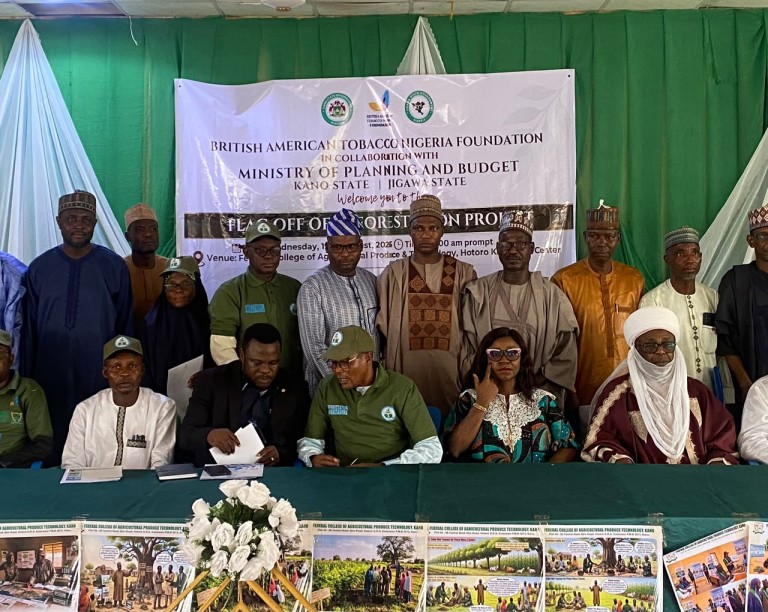
The British American Tobacco Nigeria Foundation has launched a 22,000-tree afforestation project across 11 local government areas in Kano and Jigawa States, deliberately pairing environmental restoration with income generation for rural households.
In partnership with the Federal College of Agricultural Produce Technology and Green Legacy, the initiative focuses on high-value species—date palm, mango, guava, tamarind, baobab and neem—chosen for their dual ability to restore degraded land and deliver cash crops, fruit, and other marketable products over decades.
Board Director Mrs Ruth Owojaiye framed the effort as a practical business response to climate pressures that are already eroding soil fertility and farm output. “This project is not just about planting trees. It is about planting hope, restoring our environment, strengthening rural livelihoods and reaffirming our shared responsibility to protect the future of our communities,” she said. She noted that BATN Foundation has channelled more than N4 billion into agricultural and rural development over two decades, reaching 1.7 million beneficiaries through more than 300 projects.
Alhaji Nasiru Wada, Magajin Garin Kano and fellow Board Director, described the trees as a long-term asset class.
“A tree is an unusual kind of investment. It returns value quietly for decades through cleaner air, stronger soil, food, shade and income,” he said, urging communities to treat the plantings as equity that will compound for future generations.
Technical lead Dr Tayo Oni of FCAPT confirmed that seedling distribution and transplanting are already under way. Sustainability measures include the training of 22 Community Forest Ambassadors tasked with monitoring, sensitisation and ensuring high survival rates so the economic returns materialise. FCAPT itself contributed an extra 2,000 seedlings, with Provost Dr Salisu Salisu projecting a minimum 95 percent survival rate through sustained community engagement.
Kano State’s Director of Monitoring and Evaluation, Abbas Iliyasu Karaye, welcomed the private-sector intervention as fully aligned with state priorities that link climate resilience to economic empowerment. He indicated the project’s early reception has already prompted consideration of expanded afforestation funding in the 2027 budget framework.
By converting degraded land into productive orchard and agroforestry systems, the programme positions rural households to capture new revenue streams while reducing exposure to desertification and declining yields—delivering measurable economic as well as environmental returns across the North-West.