Follow Us on Google

By Oluseye Ojo
Political parties in Oyo State have begun to accuse one another of vandalising campaign billboards, attacking and killing supporters, as well as using intimidation to suppress opposition.
On the surface, the incidents might initially appear to be routine exchanges in the battle for electoral advantage. But in the state, political rivalries have repeatedly escalated into bloodshed.

As the 2027 general elections approach, allegations of political intimidation, attacks on campaign activities and the destruction of campaign materials are once again stirring anxiety across the state.
The latest controversies, involving the All Progressives Congress (APC), Allied Peoples Movement (APM) and Accord (A), have revived memories of a turbulent political history in which contests for power have sometimes degenerated into violence, destruction of property and prolonged hostility among rival political camps.
The state, from the fierce rivalry between the late Chief Bola Ige and the late Dr Victor Omololu Olunloyo during the 1983 governorship election in the old Oyo State to the political upheavals of 2003, the impeachment crisis involving former Governor Rashidi Ladoja in 2006, the bloody Peoples Democratic Party (PDP) primaries of 2007 and the killing of Alhaji Lateef Salako, popularly known as Eleweomo, in December 2010, has experienced several episodes that demonstrate the potentially devastating consequences of politics without restraint.

The 2015, 2019 and 2023 elections offered different political outcomes, but they did not entirely eliminate allegations of intimidation and violence from the state’s electoral landscape.
APC, APM, Accord trade accusations over violence
In September 2026, the campaign organisation of APC governorship candidate, Senator Sharafadeen Alli Campaign Organisation (SSACO), accused individuals allegedly linked to the APM and the Park Management System (PMS) of plotting to vandalise Alli’s campaign billboards and posters in parts of Ibadan.
The APM rejected the allegation, describing it as false and accused the APC campaign organisation of making inflammatory claims. It urged its rival to concentrate on issues affecting the state rather than make allegations capable of heightening political tension.
The Presidential Coordinator and Director-General of the Allied Peoples Movement (APM) Governorship Campaign Council in Oyo State, Dr. Nureni Adeniran, dissociated the party from the reported attack on members of APC. He described any attempt to link the APM to the incident as unfounded.
He urged the APC to look inward and address its internal challenges rather than implicate other political parties in matters with which they have no connection.
Adeniran noted that the APC has been grappling with internal crises that could undermine public confidence in the party, and urged its leaders to concentrate on resolving their differences and strengthening their political structure.
The APM chieftain also alleged that the APC had assembled a faction of the proscribed National Union of Road Transport Workers (NURTW) to support its political activities. He insisted that the APM should not be held responsible for any incident involving such groups.
Adeniran called on security agencies to conduct a thorough and impartial investigation into the reported attacks, identify those responsible and ensure that anyone found culpable is arrested and prosecuted in accordance with the law.
“Our campaign will be driven by ideas, policies and practical solutions to the challenges confronting the people of Oyo State. We have no interest in political violence, intimidation or any activity capable of threatening public peace.
In October, the APC campaign organisation renewed its accusations, alleging that supporters of APM governorship candidate, Bimbo Adekanmbi, had vandalised billboards belonging to Alli and his running mate, Soji Adedeji.
According to the APC campaign organisation, the affected locations included Mokola, Sango, Monatan-Olodo Road, Odo-Ona and the Toll Gate-Iwo Road section of the Lagos-Ibadan Expressway.
The organisation’s Director of Media and Publicity, Bisi Oladele, called for an investigation and the prosecution of anyone found responsible.
Stakeholders said the controversy has exposed the widening distrust among political camps, with campaign materials becoming another flashpoint in the struggle for political advantage.
The situation became more troubling on October 14, when hundreds of supporters of Accord governorship candidate, Oriyomi Hamzat, were reportedly attacked by suspected hoodlums during a procession in the Molete area of Ibadan.
The procession had been organised to welcome Hamzat back to Nigeria from the United Kingdom.
Some party members reportedly sustained injuries, while vehicles in the campaign convoy were vandalised.
The Oyo State Police Command confirmed the attack. Its Public Relations Officer, Olayinka Ayanlade, said Accord loyalists had been ambushed during what he described as a peaceful procession
The APC subsequently demanded an investigation into the incident. Also, SSACO in a statement, titled; ‘Stop shielding criminals within APM,’ challenged Governor Seyi Makinde and Adekanmbi to stop shielding members of the APM accused of criminal activities.
The organisation reacted to a statement by the Adekanmbi Campaign Organisation, which accused SSACO and the APC in Oyo State of implicating APM in the killing of an APC member, Ridwan Adeyemi, and attacks on Mrs Tawakalit Alli, wife of the APC governorship candidate; and Remi Oseni, a member of House of Representatives and APC candidate for Oyo South senatorial district,; as well as Folake Olunloyo-Oshinowo, a former member of House of Representative and the current candidate for Ibadan North West/South West Federal Constituency in Ibadan on October 7.
Director of Media and Publicity of SSACO, Bisi Oladele, rejected the APM campaign organisation’s argument that its warnings about political violence could jeopardise security agencies’ investigations.
Oladele accused the APM of offering what he described as illogical explanations for attacks on opposition figures and challenged Makinde and Adekanmbi to allow security agencies to identify and prosecute anyone responsible. He alleged that perpetrators were emboldened by political leaders and their alleged sponsors, while insisting that no resident should be killed or attacked because of party affiliation or political choice.
The APC campaign organisation also reminded Makinde that he had won the 2019 governorship election as an opposition candidate in an atmosphere of peace and had inherited what it described as a peaceful state.
It maintained that political ambition was not worth the life of any Oyo resident and promoted Alli’s Oyo-AHEAD agenda as an alternative for the state. The APC in the state also raised an alarm about the killing of Ridwan Adeyemo, popularly known as Paul Moor, an APC member and commercial motorcyclist.
He was reportedly attacked by armed men in the Ita-Barika area of Agbokojo, Ibadan North-West, on Friday, October 16.
The governorship candidate of the African Democratic Congress (ADC), Oloye Adegboyega Taofeek Adegoke, consequently warned politicians and their supporters against using violence and intimidation to discourage voters from participating in the electoral process.
He urged political actors to protect citizens’ democratic rights and prioritise peaceful campaigns, tolerance and issue-based engagement.
Deputy Director, Media and Publicity, Bimbo Adekanmbi Campaign Organisation, Moses Alao, in his response, criticised the APC and the Accord. He accused APC and its allies, including Accord of becoming irresponsible with unfounded allegations and lies’. He also called on security agencies to investigate the matter thoroughly and bring the culprits to book.
Oyo’s political history
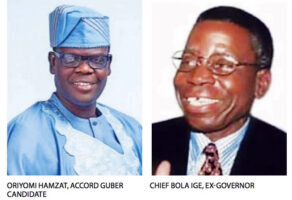
The recurring spectre of political violence in Oyo State could be traced to the 1983 governorship election in the old Oyo State. It was at a time when the late Chief Ige of the Unity Party of Nigeria (UPN) faced Dr. Victor Omololu Olunloyo of the National Party of Nigeria (NPN).
The contest was more than a struggle between an incumbent governor and his challenger. It unfolded against a backdrop of fierce political rivalry, divisions within the political establishment and tensions involving regional identity.
Ige hailed from Esa-Oke, in present-day Osun State, while Olunloyo was an Ibadan indigene. Both men were entitled to contest for the governorship, but their origins became part of the political discourse surrounding the election.
During the campaign, Ige was reported to have made a controversial remark that became associated with the bitterness of the contest.
The expression invoked the use of the flat side of a machete to deal with those who refused to listen.
The response attributed to some Ibadan supporters was equally memorable, invoking local belonging and the desire to support their own.
Then, Ige was accused of saying that Ibadan people were butchers and anyone of them who was not into butchery, must be into commercial driving.
some Ibadan people allegedly described the statement believed to have been made by Bola Ige as an insult. Then, they vowed to show Ige that Ibadan also had well-educated and brilliant people. That was how Olunloyo was brought into the contest against Ige.
Olunloyo also enjoyed the support of the National Chairman of NPN, Chief Meridith Adisa Akinloye,, and the then Minister of Justice, Chief Richard Akinjide, who both hailed from Ibadan. Since then, Ibadan has been dominating the political arena of the state .
Another influential figure in the political realignments of the period was Alhaji Busari Adelakun, popularly known as Eruobodo, an Ibadan politician, who had served in Ige’s government before breaking with the governor and aligning with the opposition.
His realignment formed part of the wider fragmentation of the political establishment ahead of the election.
Olunloyo eventually defeated Ige, but the announcement of the result was followed by protests and violence.
Other News
Destruction of political symbol in 2003
Two decades after the 1983 election, Oyo State again experienced intense political competition during the 2003 general elections.
The contest involved the then incumbent governor, Alhaji Lam Adesina of the Alliance for Democracy (AD), and PDP challenger, Senator Rashidi Ladoja.
Ladoja won the governorship election, ending the AD’s control of the state.
However, the contest was accompanied by tensions and allegations of violence that reinforced concerns about the conduct of elections.
The destruction of the statue of the late Chief Obafemi Awolowo in front of the Oyo State Government Secretariat in Ibadan became one of the episodes associated with the political upheaval of the period. The 2003 experience also preceded another major crisis: the struggle between Ladoja and his political benefactor, the late Chief Lamidi Adedibu, often described as a strongman of Ibadan politics,.
Ladoja’s impeachment
The crisis between Ladoja and Adedibu became one of the most consequential political confrontations in Oyo State’s Fourth Republic.
After Ladoja assumed office in 2003, disagreements developed between the governor and Adedibu, an influential Ibadan politician, whose political machinery had helped the PDP secure power.
The dispute eventually split the ruling party and drew the state into a protracted struggle over political influence and control.
In July 2005, 18 members of the Oyo State House of Assembly aligned against Ladoja, while another group opposed his removal.
The confrontation escalated in January 2006, when lawmakers loyal to Adedibu moved to impeach the governor.
The proceedings were accompanied by violence, including clashes involving armed supporters and the destruction and looting of property at the Government House.
Human Rights Watch documented the involvement of armed factions and political loyalists in the confrontation.
Ladoja was removed from office in January 2006 and replaced by his deputy, Christopher Adebayo Alao-Akala.
However, the Supreme Court ruled in December 2006 that the impeachment was invalid because it did not secure the constitutionally required two-thirds majority of the House of Assembly. Ladoja subsequently returned to the office.
Battle that travelled from Akure to Ibadan in 2007
If the 1983 election illustrated the danger of inflammatory political rhetoric, the 2007 PDP governorship primary demonstrated how an internal party struggle could spill beyond its original setting and become a deadly confrontation.
By then, the relationship between Ladoja and Adedibu had deteriorated sharply.
Although Ladoja had returned to office in December 2006 after the Supreme Court invalidated his impeachment, his reinstatement did not resolve the struggle for control of the PDP’s political machinery or determine who would carry the party’s flag in the 2007 governorship election.
Ladoja wanted to retain his political influence, while Adedibu backed Alao-Akala, Ladoja’s estranged deputy, who had briefly served as governor during the impeachment crisis.
The confrontation reached a flashpoint on February 3, 2007, at a PDP zonal rally in Akure, Ondo State, where Alao-Akala was formally presented with the party’s governorship flag.
Rival groups aligned with the opposing camps clashed. Accounts of the incident described heavily armed factions of the National Union of Road Transport Workers (NURTW) attacking one another, with gunshots, damaged vehicles and casualties. A Human Rights Watch investigation reported that at least four people were killed in clashes associated with the Akure rally.
The organisation also documented how rival transport-union factions had become instruments in the political struggle between the two camps.
But the violence did not end in Akure.
As the rival groups returned to Ibadan, the confrontation spread into the state capital, where further clashes resulted in additional deaths, injuries and destruction of property.
Eleweomo’s killing and the bloody road to 2011
The period preceding the 2011 governorship election produced another defining episode in Oyo State’s history of political violence.
On December 30, 2010, Alhaji Lateef Salako, popularly known as Eleweomo, was killed during a violent confrontation at a PDP local government congress in the Olunloyo area of Ibadan.
Salako was a prominent figure in the NURTW and had become associated with the violent factional struggles that characterised the state’s transport-union politics. The incident occurred amid a prolonged crisis within the PDP and rivalries involving supporters of Alao-Akala, then governor, and other influential political actors.
Contemporary media reports said two other people were killed in the violence, while several others were injured. Vehicles were also reportedly burnt. The incident triggered fears of reprisals and further clashes in parts of Ibadan.
By the time the 2011 governorship election approached, Oyo State was already burdened by years of political and factional violence. Subsequent incidents around transport parks and political activities reinforced concerns about the security challenges confronting the state.
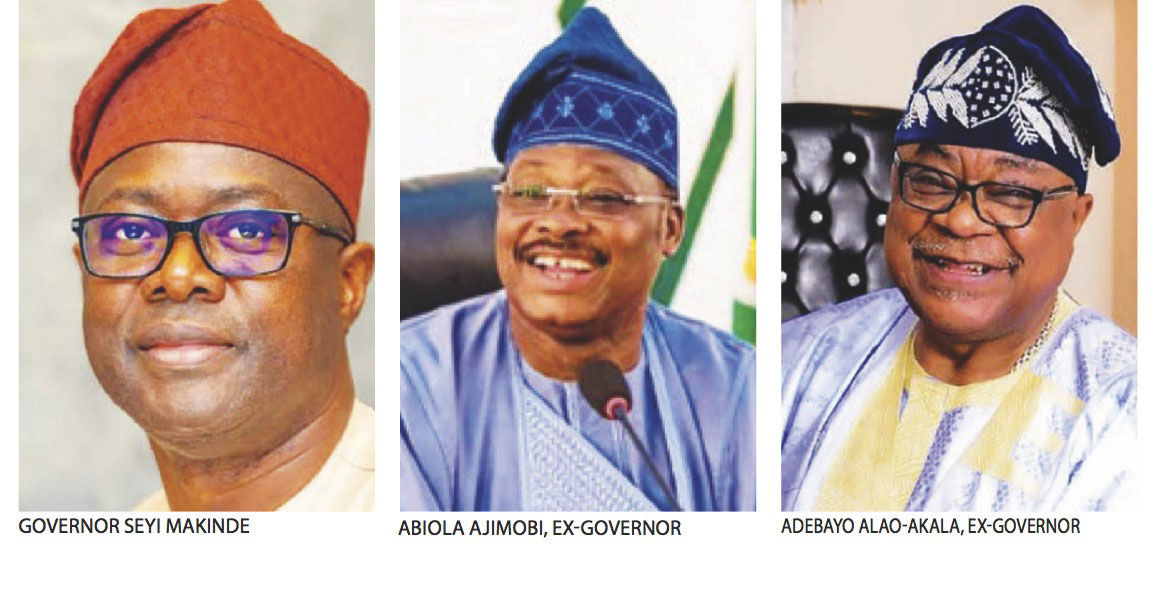
Eventually, Chief Abiola Ajimobi of the Action Congress of Nigeria (ACN), which became APC in the build up to the 2015 polls, won the election.
2015: Ajimobi and Ladoja’s fierce contest
The 2015 governorship election produced another major political confrontation, this time between incumbent Governor Abiola Ajimobi of the APC and former governor Ladoja of the Accord.
Ajimobi sought re-election, while Ladoja returned to the governorship race after his earlier tenure and the prolonged conflicts that had shaped his political relationship with other major actors. The election was closely watched because of the fierce rivalry between the two politicians.
After the April 11 poll, Ajimobi was declared the winner with 327,310 votes, while Ladoja polled 254,520.
Ladoja rejected the outcome and challenged the result at the election petition tribunal, alleging irregularities and acts of violence.
Ajimobi, on his part, maintained that the election had been properly conducted. The tribunal dismissed Ladoja’s petition in October 2015, holding that the allegations had not been established by credible and reliable evidence. The legal challenge was resolved in Ajimobi’s favour. The results of the election showed that Àjimobi won his re-election bid with 32 per cent of the total votes cast, while all other opposition parties put together scored 68 per cent.
Change of government amid rivalry in 2019
The 2019 governorship election marked another important turning point. Makinde, then the PDP candidate, defeated the incumbent APC governor, Ajimobi, whose party fielded Adebayo Adelabu as its candidate. He won the election and was sworn in as governor on May 29, 2019.
.
Violence returns to campaign trails in 2023
The 2023 governorship election again raised concerns about political violence in Oyo State.
Makinde sought a second term on the PDP platform, while the APC fielded Senator Teslim Folarin and Accord presented Adelabu.
In the weeks preceding the election, the parties exchanged allegations over attacks on campaign activities and the destruction of campaign materials. One notable incident occurred in Igangan, Ibarapa North Local Government Area, where Makinde’s campaign train was attacked on February 1, 2023. The governor condemned the incident, while his campaign organisation alleged that suspected opposition thugs were responsible. The APC, however, had accused men associated with the PMS of triggering the crisis. Adelabu also accused the governor of condoning violence. Despite the tensions, the governorship election was conducted on March 18, 2023, and Makinde was declared the winner. He secured 563,756 votes, ahead of Folarin’s 256,685 and Adelabu’s 38,357, according to the declared results.
Police begin probe, warn politicians
The Oyo State Police Command has commenced an investigation into the October 14 attack on supporters of Accord governorship candidate Oriyomi Hamzat in Molete, which claimed the life of 40-year-old Azeez Tajudeen.
The Commissioner of Police, Abimbola Ayodeji Olugbenga, directed that the case be transferred to the Command Monitoring Unit for a thorough and discreet investigation.
The police also urged political parties and organisers to notify the Command at least 48 hours before public processions and gatherings.
When contacted for an update on the number of arrests made in connection with reported cases of political violence in the state, the Police Public Relations Officer, Olayinka Ayanlade, said investigations were ongoing. He, however, urged politicians to embrace peace and shun violence as political activities gather momentum ahead of the 2027 general elections.
“My advice to politicians is to prioritise peace. Thuggery and brigandage should be resisted. Remember that you are going to govern the people after the elections. If you kill them, who will you govern?” he asked.