Follow Us on Google
By Ndubuisi Orji, Abuja
It is generally believed that the opposition is too fragmented to confront the ruling opposition All Progressives Congress (APC). From the street to the headquarters of the respective political parties, there is a near consensus that an alliance of opposition political parties is imperative, to defeat President Bola Tinubu and the APC in the 2027 polls. But the question is: Can the opposition forge a common front for next year’s polls?
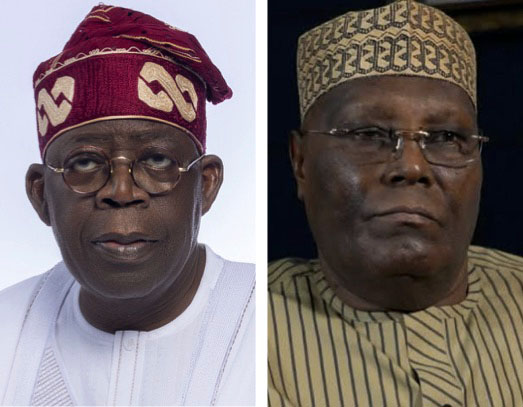
The desire for an alliance is a fallout of the outcome of the 2023 general election, where the scores of the three major opposition parties combined surpassed, the votes polled by Tinubu to win the presidential contest. The President had scored a total of 8,794,726 votes to clinch the coveted seat.
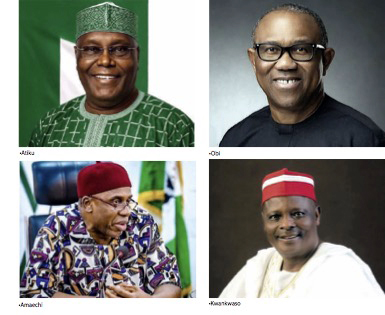
On the flipside, former Vice President Atiku Abubakar, who contested on the platform of the Peoples Democratic Party (PDP) polled a total of 6,984,520 votes, with former Anambra governor, Peter Obi of the Labour Party and former Kano State, Rabiu Kwankwaso, who was candidate of the new Nigeria Peoples Party (PDP) polled 6,101,533 votes 1,496,687 votes respectively.
In the aftermath of the 2023 polls, opposition politicians started exploring the possibility of an alliance that would confront and defeat the APC in the 2027 general election. Last year, Atiku and Obi alongside other key opposition figures, including former Senate President, Senator David Mark, former Osun governor, Rauf Aregbesola, former Rivers State governor, Chibuike Amaechi unveiled the African Democratic Congress (ADC) as the “coalition party” for 2027 polls. Kwankwaso later joined the ADC this year.
Expectedly, hopes soared that with Atiku, Obi and Kwankwaso on one platform, opposition unity for the 2027 polls was a done deal. However, that hope evaporated earlier in the year, after Obi, Kwankwaso alongside their supporters dumped the ADC for the Nigeria Democratic Congress (NDC). Inside sources say the exit of the former Anambra State governor and his Kano counterpart was not unconnected to alleged internal contradictions within the ADC.
After the parting of ways, Atiku emerged the ADC presidential candidate with former Rivers governor, Rotimi Amaechi as his running ate, while the former Anambra governor and Kwankwaso clinched the NDC presidential and vice-presidential tickets respectively.
Apart from Atiku and Obi, there are 16 other opposition presidential candidates, including Seyi Makinde, Donald Duke and Adewale Adebayo of the Allied Peoples Movement (APM) respectively. The development has fuelled fears that like in 2023, the opposition would be approaching the 2027 contest with a divided house.
Push for opposition unity
Recently, a group of opposition politicians on the aegis of G-100 initiated a move to get the opposition parties to prosecute the 2027 genera election on a common platform. The Group, in a open letter dated August 2 to the leadership of the ADC,NDC, APM , SDP PRP and the PDP, as well as Civil Society Organisations (CSO) stated that it would be difficult for a fragmented opposition to defeat the APC.
After weeks of consultations with opposition leaders, the G-100, midwifed a summit of opposition political parties on August 31. At the end of the summit, the six political parties resolved to set up five working groups to draft a framework for the proposed collaboration. One of the working groups is saddled with the task of producing a framework for a consensus presidential candidate for the 2027 general election within four weeks.
While the other four other working groups are to draft a National Covenant for Democratic Renewal, Single-Term Transition Charter, National Reform Programme and Framework for Opposition Unity all within four weeks. In addition, the opposition parties also agreed to establish Central Leadership Committee, to provide overall political direction and coordination of the cooperation process, and to serve as the final arbiter on matters referred to it by the Working Groups; a Publicity and Communication Committee and Legal Committee.
Salihu Lukman, who spoke on behalf of the G-100, in his welcome address, implored the opposition leaders to think about what played out in the 2023 general election, while the opposition combined pulled more votes than the ruling party.
According to him, “The winner took just under nine million votes. One opposition candidate took close to seven million. Another took just over six million. Thirteen million votes on one side of the argument, under nine million on the other. And the side with fewer votes formed the government, lawfully, constitutionally, and entirely predictably. Distinguished ladies and gentlemen, that is not a conspiracy. Nobody stole thirteen million votes. We divided them ourselves, in public and we did it knowing exactly what the consequence would be.”
Other News
Lukman pointed out “in Kenya in 2002, a party that had governed for thirty-nine years was removed, not by a new idea, but by an opposition that finally agreed to be one opposition. In Malaysia in 2018, a coalition that had governed for sixty-one years was removed in much the same way, by people who had been each other’s prosecutors and each other’s prisoners. In neither case did the opposition win because it had become more virtuous. It won because it had become one.”
Like Lukman, the National Chairman of the PRP, Hakeem Baba-Ahmed opines that a unity of the opposition is crucial to defeating the APC in 2027. Baba-Ahmed, while stating that all the six participating opposition political parties have one legal battle or the other, opined that none of the parties can confidently say that it can prosecute the next presidential election successfully on its own.
”We are not here because we are too weak. We are here because we believe the fight to get this Tinubu out of power and to put one of us or all of us in power is absolutely imperative in this country. It must happen, and with the support of Nigerians, it will happen. No party will be honest enough to tell you that alone it can defeat the APC. None.“
Hurdles to consensus presidential candidate
The G-100, no doubt, has effectively set the ball rolling in the quest for a single opposition presidential candidate for next year’s presidential poll. Nonetheless, pundits say it is not going to be a walk in the park, especially as there ae several hurdles the opposition must scale to achieve its desired collaboration for the January 16, 2027 presidential poll.
Analysts say that the key to a successful alliance lies with Atiku and Obi, as well as their running mates and respective political parties, as well as their supporters. The challenge all along has been how to arrive at a consensus between the two camps. The issue has always been who will step down for the other. And it is doubtful if the former Vice President would accept step down for any candidate in the 2027 poll.
Atiku, who has had his gaze on the Presidency since 1992, and making it to the ballot on three different occasions, has stated that the 2027 general election would be his last. Besides, loyalists of the former Vice President believe that being the only northerner contesting the 2027 general election on the platform of a major opposition party makes his chance of winning the election very bright.
On the flip-side, it is also unlikely that the Obi camp would accept for him to withdraw from the 2027 presidential contest. The Anambra governor, whose participation in the 2023 general election redefined presidential contests in the country since the inception of the present democratic dispensation, is largely perceived across the country as a breadth of fresh air.
Against that backdrop, it would be an uphill task for his supporters to allow step down from the contest. There are also the political interests of two Vice presidential candidates, who are believed to be interested in succeeding their respective candidates, in the event that their party wins the 2027.
Besides, pundits say the opposition do not have the luxury of time. Checks reveal that the opposition has between now to October 16 to conclude on the issue of a consensus candidate, the other opposition candidate can formally withdraw from the contest to avoid ambiguity among their supporters. Section 31 of the Electoral Act 2026 prescribes that candidates, who have been validly nominated by their political parties shall can withdraw not later than 90 days to the polls. Therefore, since the presidential polls has been scheduled for January 16,2027, the opposition must conclude its arrangement within the next six weeks.
This is not the first time the opposition would be forging an alliance or exploring a collaboration since the inception of the present democratic dispensation. In 1999, the defunct All Peoples Party (APP) and the defunct Alliance Democratic (AD) entered into an alliance for the 1999 presidential poll. In the partnership, the APP produced the presidential candidate, while AD produced the vice-presidential candidate.
Similarly, in 2013, the defunct Congress for Progress Change (CPC), the defunct Action Congress of Nigeria (ACN), the defunct All Nigeria Peoples Party (ANPP) and a splinter group from the PDP and the All Progressives Grand Alliance (APGA) fused to form the APC, which eventually sacked the PDP from power in 2015.
However, this the first opposition would be exploring a collaboration after campaigns have commenced. While, analysts say the timing would undoubtedly pose some challenges as the G-100 try to get the six political parties to agree on a single presidential candidate.
Therefore, as the opposition working groups begins work on the framework that would guide choice of singe presidential candidate, the question would be which of the presidential candidates is better placed to secure victory for the opposition in the 2027, and how to cater for the interest of all the parties, as well as the sincerity of purpose among the political parties. While the G-100 is optimistic on the possibility of a single opposition presidential candidate, Nigerians are waiting to see how far the group can go in the pursuit of this objective.