Follow Us on Google
•What opposition parties’ leaders must do to wrest power
From Fred Itua, Abuja
Nigerian opposition politics has rarely lacked drama, but it has consistently lacked discipline. The recurring pattern, fractious alliances forged in desperation, dissolved in ego, and mourned in defeat, has made the ruling All Progressives Congress (APC) the principal beneficiary of an opposition that chronically mistakes noise for strategy.
Sadly, as political pundits have noted, 2027 approaches with the weight of economic hardship, infrastructural decay, and a citizenry visibly exhausted by the gap between governance and lived reality. These realities have thrown up structural questions that are crystallising with unusual urgency. Can the Peoples Democratic Party (PDP), the Labour Party (LP), and the African Democratic Congress (ADC) forge a coalition durable and coherent enough to mount a credible challenge to President Bola Ahmed Tinubu and the APC machine?
The answer is neither straightforwardly yes nor no. It is, more honestly, conditional, contingent on whether Nigeria’s opposition leadership possesses the rarest of political virtues; the willingness to subordinate personal ambition to collective purpose.
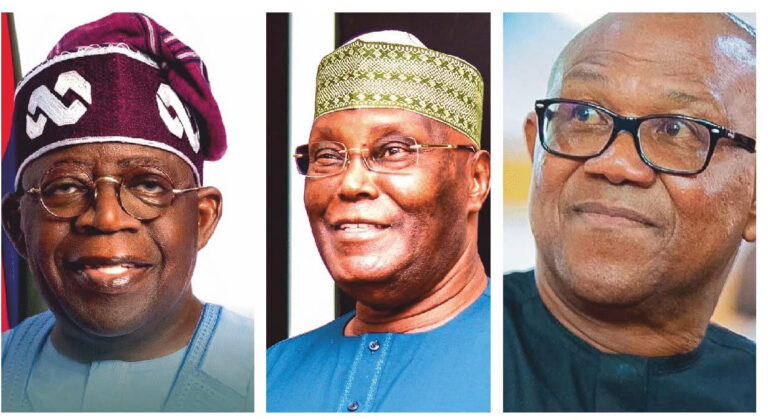
The raw numbers make a compelling opening argument. In the 2023 presidential election, Peter Obi of the Labour Party secured approximately 6.1 million votes. Atiku Abubakar of PDP garnered around 6.98 million, and Rabiu Kwankwaso of the NNPP added over 1.4 million. Bola Tinubu won with roughly 8.7 million votes; a figure that, in a different configuration of opposition forces, would have been insufficient.
The arithmetic is straightforward even if the politics are not: a consolidated opposition ticket in 2023 would very likely have produced a different president.
This argument for political observers, is not merely retrospective arithmetic. For them, it reflects a structural reality of Nigerian multiparty elections that the APC’s dominance is partly a product of opposition fragmentation rather than an organic majority will.
Many Nigerians across the divide, argue that the Tinubu administration’s first two years, marked by the removal of fuel subsidies, naira devaluation, spiralling food inflation, and a cost-of-living crisis with no immediate remedies in sight, have not softened the political environment for the ruling party. If anything, the conditions have ripened for a serious oppositional convergence.
The PDP, despite its internal convulsions, remains the most geographically distributed opposition structure in the country. Its gubernatorial footprint across states like Rivers, Bauchi, Adamawa, Taraba, Akwa Ibom, Cross River, Oyo, Osun, and Enugu gives it a network infrastructure that no other opposition party can replicate. It also carries, however, the baggage of 16 years of federal governance, a record the APC will weaponise relentlessly.
The Labour Party’s significance is generational and demographic. Peter Obi’s 2023 campaign mobilised a previously politically dormant segment of Nigerian society: urban, educated, technologically engaged, deeply cynical about the old parties in a manner that no opposition movement had achieved in recent history.
The “Obidient” movement, for all its subsequent disappointments, demonstrated that structural apathy among younger Nigerians is not immutable. Observers opine that if LP can consolidate rather than squander that coalition, it will bring an energy and a legitimacy among first-time and young voters that neither the PDP nor ADC can manufacture.
The ADC, smaller in comparative footprint but strategically relevant, carries specific regional and elite networks that matter in a country where the involvement of local political brokerage determines outcomes at the ward level. The value of ADC in a coalition is less about vote mass, but about filling in geographic and demographic gaps.
For the opposition, the obstacles are formidable and rooted not merely in personality clashes, though those are considerable, but in structural incompatibilities.
The PDP’s internal crisis, revolving around the unresolved tensions between the Atiku faction, the Nyesom Wike axis, and newer internal constituencies, means that any coalition arrangement would need to first resolve what PDP is before it can credibly offer a unified front. A party negotiating externally while haemorrhaging internally is not a reliable coalition partner. It is a liability, observers believe.
The Labour Party, on its own, faces its credibility challenge. The post-2023 period has exposed tensions between the party’s legacy structure and the new, largely informal Obidient movement. Peter Obi’s own political positioning, hovering between idealism and pragmatism, has occasionally left his supporters uncertain about the party’s strategic direction. A coalition that demands Obi subordinate his candidacy to a PDP figure, or vice versa, risks fracturing the very coalition before it launches.
The question of who flies the coalition’s presidential flag is perhaps the most explosive challenge for the key actors. In Nigerian political culture, the willingness to accept a vice-presidential slot or a later-cycle arrangement requires an extraordinary degree of trust between parties that have spent recent years competing against each other, and in some cases, exchanging bitter public recriminations.
Coalition politics in Nigeria has historical precedent. The merger that produced the APC in 2013, bringing together the ACN, CPC, ANPP, and a faction of APGA, demonstrated that Nigerian parties can achieve structural consolidation when the incentive is sufficiently large. That coalition unseated an incumbent president in 2015, a genuinely historic feat.
Other News
But the graveyard of failed Nigerian opposition alliances is equally instructive. The Coalition of United Political Parties (CUPP) produced press statements with more reliability than it produced political outcomes. The pattern has been consistent: coalitions announced with fanfare, hollowed out by elite negotiation failures, and dissolved before they matter.
The difference in 2027 is that the stakes have risen. Political analysts believe that Nigeria’s economic condition has created genuine mass discontent of a kind that can translate into electoral energy if properly channelled. The APC’s vulnerabilities, the Tinubu administration’s perceived unpopularity on economic management, questions around governance transparency, and a 2027 incumbent campaign that will need to defend a difficult record, are real.
An opposition that can hold together long enough to present a coherent alternative may find a more receptive electorate than in previous cycles.
For such a coalition to be more than performative, observers believe that it requires several non-negotiable foundations. First, they argue that a negotiated power-sharing framework agreed well in advance of the election season, not assembled in frantic pre-deadline meetings. Second, an independent coalition secretariat that sits above individual party structures and enforces commitments.
Third, a candidate selection process that uses credible, transparent criteria rather than backroom brokerage, ideally involving primary-adjacent mechanisms that give ordinary supporters a stake in the outcome. Fourth, a policy platform ambitious and specific enough to give Nigerians something to vote for rather than simply something to vote against.
Arguing further, they opine that the negotiations also require the parties to accept an uncomfortable truth: that the coalition’s presidential candidate need not come from the largest constituent party, but from whichever figure commands the broadest coalition of support across region, religion, and generation. That calculation, for them, may or may not point to an Atiku, an Obi, or an as-yet-undeclared figure. “What it cannot survive is the imposition of any figure through the kind of elite bargaining that alienates the base even before the campaign begins,” Charles Agbo a lawyer noted.
The presidential candidate of the Labour Party in the 2023 general elections, Mr Peter Obi, recently advanced the argument on a possible future coalition against the ruling APC, ahead of the polls next year.
Obi, while supporting the call, said: “Let me set the record straight. I am not against coalition. In truth, I am for it not for a power grab but to position Nigeria for greatness. I have not, and will never, advocate any coalition or alliance that does not prioritise the welfare and progress of the ordinary Nigerian.
“Any discussion about governance must centre on what it means for the everyday Nigerian, how it will address critical issues such as access to quality healthcare, and education, and pulling people out of poverty.
“Too often in our nation’s history, individuals and groups have come together solely for the purpose of taking power for power’s sake. Such endeavours, devoid of genuine purpose and vision, have only deepened our challenges, leaving the ordinary Nigerian to bear the brunt of bad governance. This is what I stand firmly against.
“Leadership must be about service, not self-interest. It must be about building a nation where opportunities abound for all, where justice and equity are non-negotiable, and where governance works for the people, not against them.
“As I have always maintained, the New Nigeria is possible. But it requires us to change the way we think about power. It is not about grabbing it; it is about using it responsibly to transform lives and secure a brighter future for generations to come.”
National Publicity Secretary of the ADC, Bolaji Abdullahi also hinted recently of a possible coalition. He said the New Nigerian Peoples Party (NNPP) and the PDP are in talks to forge ahead and align with the ADC to wrest power from the ruling APC in 2027.
Abdullahi noted that the alliance is not all about taking power from President Bola Tinubu, but focused on good life for the people
Observers who have carefully followed the trend, argue that beyond electoral arithmetic, there is need for a coalition that transcends party interest. Nigeria’s political health depends on the existence of a credible alternative government-in-waiting, it noted. Single-party dominance, even when that party is elected, produces governance without accountability, because the ruling party knows that the opposition cannot coherently replace it.
The consolidation of opposition forces into a serious coalition is not merely a tactical calculation for ambitious politicians. It is an institutional contribution to the quality of Nigerian democracy itself.
The 2027 general elections will arrive, as elections do, regardless of opposition preparedness. The question is whether Nigeria’s political opposition has finally learned that the luxury of competitive fragmentation belongs to parties that can afford to lose, and that, given what is at stake, they cannot.