Follow Us on Google

From Noah Ebije, Abuja
The Independent National Electoral Commission (INEC) has warned political leaders, supporters and other stakeholders against the use of threatening political rhetoric capable of triggering violence ahead of the 2027 general elections.
The commission specifically expressed concern over the growing popularity of the slogan “Rig and Die”, warning that language linking electoral offences to death could create an atmosphere of hostility and endanger the lives of voters, electoral officials and other stakeholders.
INEC also cautioned Nigerians against spreading false information suggesting that Permanent Voter Cards (PVCs) would no longer be required for voting in the 2027 elections, insisting that presentation of a valid PVC remains mandatory under the Electoral Act 2026.
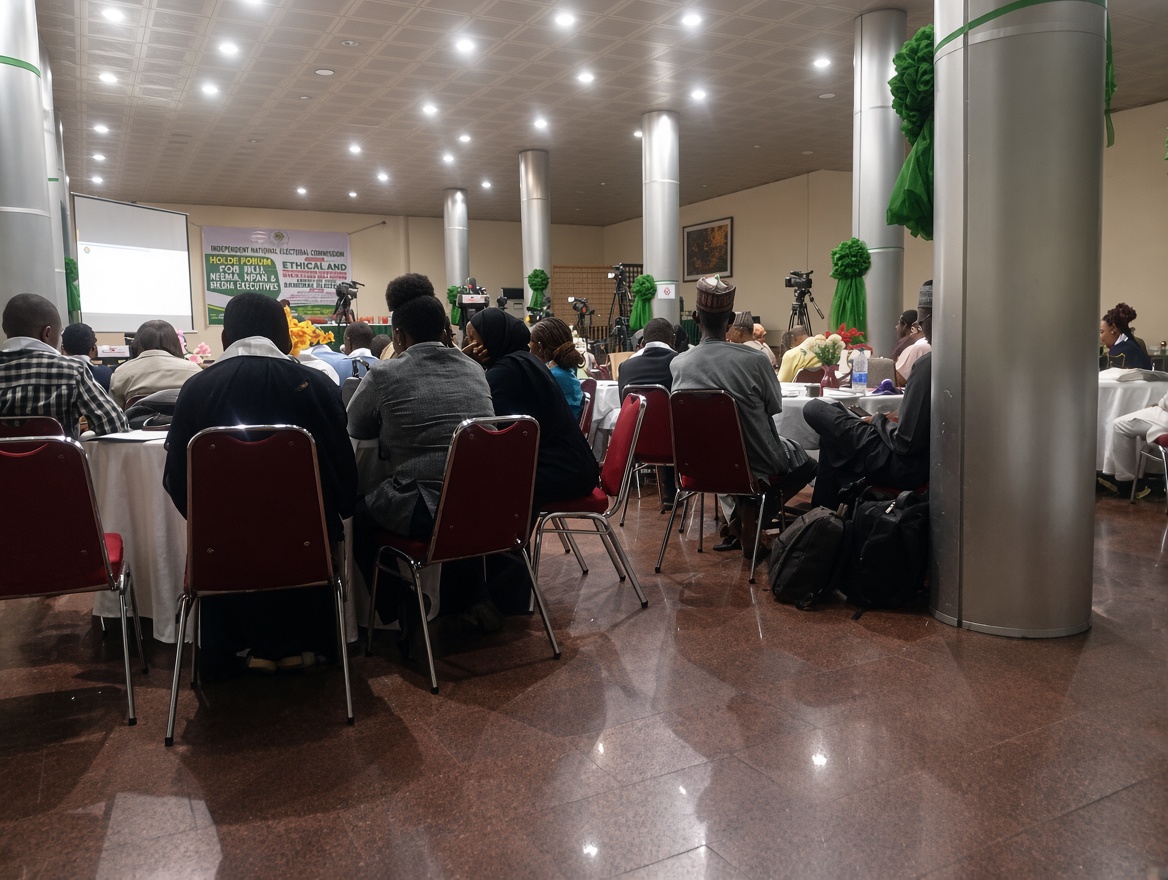
The commission’s position was contained in the opening remarks of the National Commissioner and Chairman of its Information and Voter Education Committee, Malam Mohammed Kudu Haruna, at a media forum organised for the Nigeria Union of Journalists (NUJ), the Nigerian Institute of Social Media Analysts (NISMA), the Newspaper Proprietors’ Association of Nigeria (NPAN) and media executives.
The forum, held at Rockview Royale Hotel, Abuja, on Monday, was themed “Ethical and Professional Standards in Election Reporting Ahead of the 2027 Election”.
Haruna, who was represented at the occasion by the Deputy Director of Information and Publicity, Mr Wilfred Ifogha, said the media had a critical responsibility to protect public confidence in the electoral process through accurate, balanced and professional reporting.
He said: “Between the commission and the Nigerian people stands the media. Most citizens will never see a polling unit being set up, a BVAS device at work, or a result sheet being signed. They may know these things only through what you tell them.
“Public confidence in our elections therefore rests to a remarkable degree on the credibility of your reporting.”
He stressed that ethical election reporting was not a favour to INEC but a responsibility to the Nigerian public, urging journalists to verify information before publication, distinguish official results from projections and avoid inflammatory language.
“Ethical election reporting is not a favour to INEC; it is a service to the public,” he declared.
The National Commissioner further urged media organisations to separate news reports from political advertisements, provide fair coverage to all candidates and political parties, correct errors promptly and avoid hate speech.
Expressing concern over the growing tension in the country’s political environment, Haruna said the commission had observed increasing negative rhetoric, abusive exchanges among supporters of rival candidates, threats against political opponents and attacks on the integrity of electoral institutions.
“Some of it appeals to ethnic or religious sentiments. Some of it hides behind a slogan. All of it carries a cost because language that casts fellow citizens and electoral officials as enemies to be defeated, rather than compatriots to be persuaded, prepares the ground for violence,” he warned.
On the slogan “Rig and Die”, he said: “Whatever its originators intend, and some insist it is aimed only at those who rig, a slogan that links an electoral offence to death is dangerous.”
He explained that ordinary Nigerians, including presiding officers, assistant presiding officers, collation officers, voters, party agents and observers, were the people most exposed to the consequences of election-related violence.
According to him, a delay in announcing results, technical challenges or rumours could easily be misinterpreted as evidence of electoral manipulation and trigger dangerous reactions.
“Rigging is a crime, and the Electoral Act 2026 prescribes penalties for it. The remedy lies in the law: vigilant observation, transparent results on the IReV, formal complaints to the commission and the security agencies, and where necessary, the courts,” he stated.
Haruna appealed to political leaders and their supporters to abandon threatening expressions, while urging journalists not to amplify such slogans through sensational headlines, hashtags or trending topics.
“I appeal to you in the media not to amplify it as a headline, a hashtag, or a trending topic. Report it where it is news, but with its context, the legal position, and the safety of electoral officials in view,” he said.
He added that threats of violence were not legitimate political debates but offences that required the attention of security agencies.
The INEC commissioner also raised the alarm over misinformation circulating on social media, particularly claims that Nigerians would be allowed to vote in 2027 without their PVCs.
He described such claims as false and potentially capable of disenfranchising unsuspecting voters.
“Let me restate the position of the law plainly. Section 47(1) of the Electoral Act 2026 requires every person intending to vote to present a valid PVC for accreditation at the polling unit where he or she is registered.
“The BVAS then verifies the card and the biometrics of the person presenting it. It confirms the voter; it does not replace the card. No PVC, no accreditation, no ballot paper,” he emphasised.
He warned that voters who believed the misleading information might fail to collect their cards or arrive at polling units without them, only to be denied accreditation.
He therefore urged journalists to take responsibility for combating fake news, deepfakes, doctored images, cloned voices and other forms of digital misinformation.
Other News
“The answer is simple, and it begins with you. Voters should collect their cards without delay and ask INEC whenever they are in doubt. That is why I am asking you today to stand as a bulwark against fake and misleading news,” he said.
He further advised media practitioners to treat viral posts, screenshots, audio recordings and videos as information requiring verification rather than material for immediate publication.
“Verify before you publish. Treat every viral post, screenshot, audio clip, and video as a lead to be checked, not a story to be run. Check any claim about INEC with us before it goes out,” he added.
On the forthcoming elections, Haruna disclosed that the presidential and National Assembly elections were scheduled for Saturday, 16 January 2027, while governorship and State Houses of Assembly elections would hold on Saturday, 6 February 2027.
He said the commission was working in accordance with the timetable released under the Electoral Act 2026, which was signed into law on 18 February 2026.
He also announced that INEC would conduct a nationwide mock accreditation and voting exercise on Saturday, 28 November, across the 36 states and the Federal Capital Territory.
According to him, the exercise would take place in two polling units in each registration area, also known as a ward, to test the commission’s technological and operational preparedness.
He explained that the exercise would simulate a presidential election, with polling units expected to open at 8:30am and accreditation running until 2:30pm.
The exercise, he clarified, would not be an actual election, and no winners or losers would be declared.
“Its value lies in finding faults while there is still time to fix them. So a fault recorded on Saturday is the exercise doing its job. I ask you to report it as a test,” he said.
The National Commissioner also highlighted provisions of the Electoral Act 2026, including compulsory use of the Bimodal Voter Accreditation System (BVAS) for voter accreditation and the upload of polling unit results to the INEC Result Viewing Portal (IReV).
He said the law also provided penalties for results manipulation, vote buying and obstruction of the upload of polling unit results.
Haruna assured Nigerians that electoral officials found compromising the process would face legal consequences.
“Any staff or ad hoc official who compromises an election will face the full weight of the law,” he stated.
He added that the commission was working towards ensuring that electoral officials and materials arrived at polling units by 7:30am on election day, noting that unnecessary delays could breed suspicion among voters.
On media coverage, he urged journalists to pay greater attention to women, young people and persons with disabilities, whose experiences and challenges during elections were often underreported.
He said their participation and the barriers they encountered in accessing polling units deserved adequate attention in election reporting.
Haruna also urged media organisations to intensify voter education, particularly on PVC collection and voter turnout, recalling that only 26.72 per cent of registered voters participated in the 2023 presidential election.
He identified three major responsibilities for journalists ahead of the 2027 elections: sustaining voter education, investigating and exposing vote buying, and partnering with INEC to combat disinformation and threats capable of undermining the electoral process.
“In summary, I ask three things of this gathering. First, sustain your voter education, especially on PVC collection and turnout, since only 26.72 per cent of registered voters voted in the 2023 presidential election.
“Second, investigate and expose vote buying. And third, be our partners in defeating disinformation, deepfakes, and fake accounts, and in refusing to give a platform to threats and incitements,” he said.
He reaffirmed the commission’s readiness to work with media organisations and encouraged journalists to seek clarification from INEC before publishing reports concerning its activities.
According to him, the commission’s official website, verified social media accounts and Citizens Contact Centre remained available for inquiries and information verification.
Haruna expressed appreciation to the NUJ, NISMA, NPAN and other media organisations for their collaboration, urging participants to engage actively in the discussions.
He said the credibility of the 2027 elections would depend not only on the commission’s preparations but also on the quality of information available to voters.
“In a few weeks, the Nigerian voter will make a decision in the privacy of the voting cubicle. What goes into that decision, the facts, the tone and the trust will be shaped by what you publish between now and then. Let us make sure it is the truth,” he said.