Follow Us on Google
By Oluseye Ojo
The battle for the governorship seat of Oyo State ahead of the 2027 general elections is fast evolving into one of the most intriguing political contests in the South West of Nigeria.
What initially appeared to be a familiar rivalry between the ruling Peoples Democratic Party (PDP) and the opposition All Progressives Congress (APC) is gradually transforming into a wider political struggle, involving emerging third-force, and a potential fourth force, capable of re-sharpening the political calculations ahead of the elections.
Also, succession intrigues, elite alignments, party crises, religious balancing and underground negotiations, media influence, and growing voter impatience with conventional politics, have also been identified as tendencies that could reshape the political future of the state.
Across Ibadan, Ogbomoso, Oyo town, Oke-Ogun and Ibarapa, political discussions have intensified over who succeeds Governor Seyi Makinde on May 29, 2027.
Political fault lines
At the centre of the unfolding contest are several political fault lines: the succession battle within the PDP; the APC’s struggle to manage powerful gladiators without implosion; the sudden rise of Accord as a disruptive force; the quiet emergence of the Allied Peoples Movement (APM) as a refuge for dissatisfied politicians; and the increasingly delicate conversation around religion and power rotation.
The race has already evolved into a sophisticated political chessboard where every move is calculated, every alliance carries implications and every silence may conceal ambition.
APC’s internal war before main battle
For the APC, perhaps the greatest danger ahead of 2027 is not necessarily the PDP. The bigger threat may be internal fragmentation.
A study of the political trajectory of the party since it lost governorship seat in 2019 to PDP, showed that APC has struggled to fully recover from factional disputes and leadership rivalries that weakened its electoral strength.
Although the party retained considerable grassroots structures and improved its competitiveness in the 2023 elections, unresolved tensions among major stakeholders remain deeply rooted.
Even, the recent conversations surrounding a possible consensus governorship arrangement have generated intense reactions across the political landscape in the state.
The widely-publicised consensus project around Senator Sharafadeen Abiodun Alli for governorship seat of the state, as gathered, emerged from fears among party elders that another bitter governorship primary could permanently damage the APC’s chances of reclaiming power.
Supporters of the arrangement see Alli, representing Oyo South in the National Assembly, as a relatively stabilising figure within the party. He was described as a calm, experienced and less combative personality than some other aspirants. He is widely regarded as someone capable of building bridges across different factions.
His backers insist he possesses longstanding political relationships across multiple tendencies within the APC and may enjoy broader acceptability among stakeholders weary of prolonged internal wars. On April 17, 2026, when Alli officially declared his governorship aspiration in Ibadan, he said his intention to contest was borne out of his vision to move the state forward.
“After my consultations with traditional rulers and political stakeholders across the state, I am here today to formally declare my ambition to contest for the office of Governor of Oyo State.
“I have served as Chairman of Ibadan North Local Government Area, Secretary to the Oyo State Government under our father, Senator Oba Rasidi Adewolu Ladoja. As Secretary to the State Government, I ensured effective coordination of government policies and programmes. As a Senator representing Oyo South, I have continued to raise my voice in defence of the interests of our people,” he added.
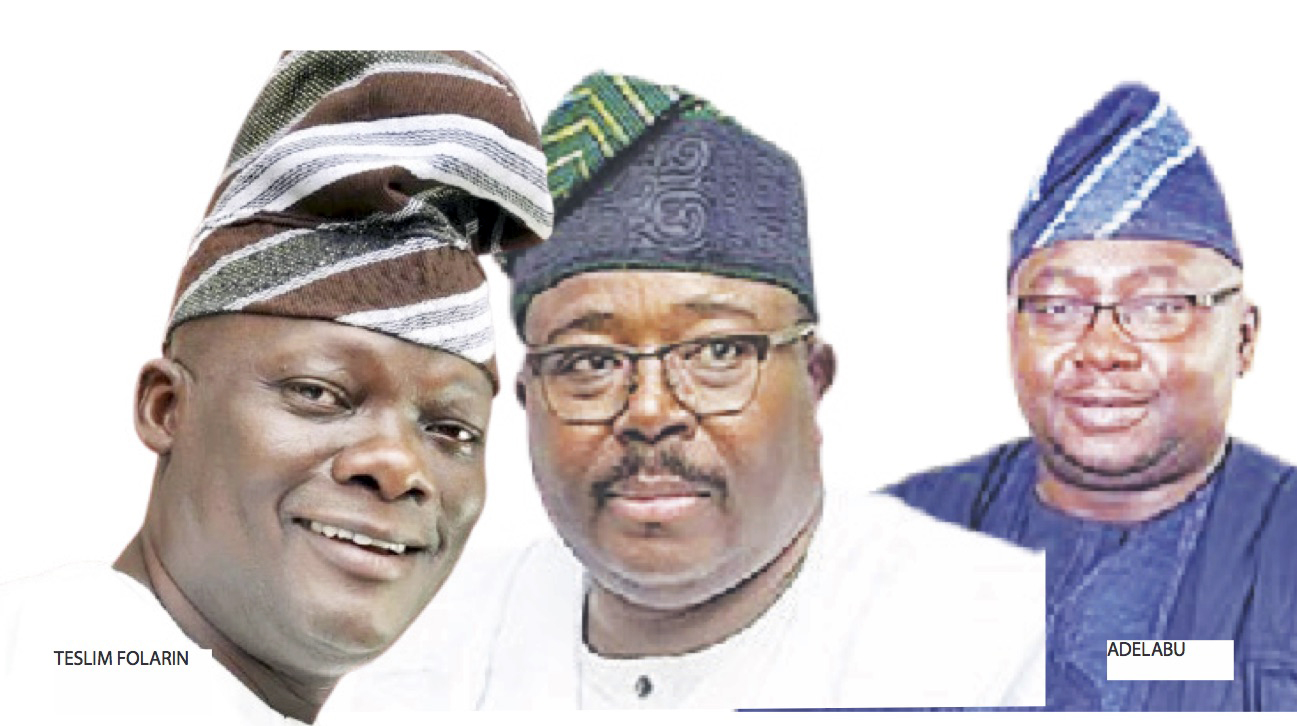
But findings revealed that Oyo APC politics has never been structured around quiet surrender. Almost immediately after consensus discussions surfaced, resistance emerged from supporters of former Minister of Power, Chief Adebayo Adelabu, who remains one of the most formidable political actors within the APC despite suffering two governorship defeats in 2019 and 2023. But Adelabu, a former deputy governor of the Central Bank of Nigeria (CBN), as gathered, commands enormous visibility, financial strength and grassroots influence, especially within Ibadan politics.
To his supporters, any attempt to sideline him through elite consensus would amount to political injustice.
Their argument is that after investing heavily in the APC since 2019 and sustaining state-wide political structures through difficult periods, Adelabu should not simply be asked to step aside because certain blocs prefer a negotiated arrangement.
Beyond his financial capacity, Adelabu’s supporters believe he still enjoys strong appeal among urban professionals, technocrats, younger voters and sections of the middle class, who view him as modern, exposed and administratively experienced. His official declaration for the governorship race on May 12, 2026, further intensified political conversations. During the launch of what he described as the ‘Oyo Rebirth Agenda’, Adelabu promised economic transformation, industrial expansion, job creation, infrastructure renewal and governance reforms.
He spoke passionately about converting Oyo State from potential to prosperity, while presenting himself as a visionary progressive, who is determined to deliver measurable results.
Yet, even as Adelabu’s structure remains active, another heavyweight continues to lurk quietly within the APC equation. He is the former Senate Leader, Teslim Folarin. Though Folarin, the 2023 governorship candidate of APC, has maintained a lower public profile since the 2023 election, insiders insist his silence should not be mistaken for withdrawal.
The former governorship candidate still controls loyal political structures across several local governments and retains influence within traditional APC networks. His deep grassroots machinery and longstanding political relationships, as gathered, make him impossible to ignore.
Consensus vs direct primaries in APC
The APC chairman in Oyo State, Chief Moses Alake Adeyemo, in his recent comments on the political development, made it known that the party might conduct direct primaries rather than rely entirely on consensus arrangements.
He said: “We set machineries in motion for us to achieve the aim of consensus across the board but reports available to me indicate that we would have to go by the second option, which is direct primary in certain cases, including the governorship ticket.
“To this end, we shall work towards organising free, fair and credible exercise in all the affected areas, even as we cannot rule out the possibility of some aspirants having a rethink and supporting the consensus arrangement as necessary.
“Where we have more than an aspirant, Abuja would send people to conduct primaries and we at the state level would provide the required support to make everything work out in the interest of our great party.”
Adeyemo stated that all registered party members would participate fully in the primaries at their respective wards on dates to be announced by the national secretariat of APC.
“For consensus, members will lend their voices for affirmation while voting will be done in the cases of direct primaries” he explained.
APC’s consensus model and internal democracy
The media have reported that the leadership of APC has endorsed the deputy governor of Lagos State, Dr Obafemi Hamzat, as a consensus gubernatorial candidate; Chairman, Senate Committee on Appropriation, Senator Solomon Olamilekan Adeola, fondly called Yayi, as consensus governorship candidate in Ogun; and Chairman, Senate Committee on Agricultural Colleges and Institutions, Senator Sharafadeen Abiodun Alli, as a consensus governorship candidate in Oyo State.
Answering a question on the consensus arrangements and internal democracy with APC, Alli defended the model, and insisted it does not undermine internal democracy within the party. He maintained that the consensus approach remains consistent with democratic principles and party guidelines. Alli, who represents Oyo South Senatorial District, said the model allows flexibility and does not foreclose competitive primaries.
“The opportunity to obtain forms is free so that it will be democratic. But that does not stop the leadership of the party in every state from adopting a consensus candidate,” he said.
“If some people decide they want to go for primaries and do not accept the consensus, so be it. We will all go there and come up with a winner.
“This shows the consensus model does not impede internal democracy; it is meant to maintain decorum.” Alli, who also dismissed insinuations that the absence of the APC state chairman, Chief Moses Adeyemo, at his endorsement event, held on Friday May 1, 2026, in Ibadan, signalled opposition, explained that certain party leaders must remain neutral.
“The party chairman will not be at a place where an aspirant is being endorsed because others may also be interested. He is a father to all and must not appear biased,” he said.
Makinde’s succession puzzle
While the APC grapples with internal balancing, Governor Seyi Makinde appears increasingly focused on the bigger question of political legacy.
Since assuming office in 2019, Makinde has successfully built one of the strongest political brands in Oyo’s recent democratic history.
Through aggressive road infrastructure projects, educational reforms, agribusiness expansion, public sector restructuring and prompt salary payments, he has expanded his influence beyond traditional PDP strongholds.
Even many critics acknowledge that Makinde has altered governance conversations within the state.
Naturally, the biggest question within PDP circles now revolves around succession. Among the names generating increasing momentum is former Commissioner for Finance, Abimbola Adekanmbi. Though Adekanmbi’s governorship ambition only recently became more visible publicly, insiders disclosed that succession discussions around him have existed quietly for months within government circles.
His recent visit to the headquarters of Fresh FM Nigeria owned by veteran broadcaster Yinka Ayefele, further amplified speculations that he may indeed enjoy strong backing within the Makinde camp.
During the visit, Adekanmbi openly pledged to sustain and expand the sectoral achievements of the Makinde administration if given the opportunity to govern the state. His message was carefully crafted around continuity.
He spoke about preserving prompt salary payments, pension reforms, infrastructural expansion and economic development policies already associated with the current administration. To Makinde loyalists, Adekanmbi represents administrative continuity and policy stability. Regarded as intellectually grounded and financially disciplined, he is viewed as one of the governor’s trusted technocrats.
However, succession politics in Oyo has never been determined solely by competence or loyalty. The state’s political history shows that grassroots connection, emotional appeal, regional balancing, political structures and identity considerations often prove decisive during elections. And this is precisely where the quiet religion conversation enters the equation.
The silent religion debate
Officially, Oyo State has never practised religious zoning. Compared to many states in Nigeria, Oyo enjoys relatively peaceful Christian-Muslim coexistence. Interfaith families are common, political alliances frequently transcend religion and communities generally maintain stable relations across faith lines.
Yet beneath that peaceful coexistence lies an unspoken political consciousness about representation and balance. Since 1999, Oyo’s governorship sequence has reflected an interesting religious pattern. The late Lam Adesina was a Muslim. He was succeeded by Rashidi Ladoja, also a Muslim. Thereafter came the late Adebayo Alao-Akala, a Christian. Then emerged the late Abiola Ajimobi, a Muslim, before the current governor, Makinde, a Christian.
That pattern has now quietly entered political discussions ahead of 2027. Many politicians privately argue that after eight years of a Christian governor, political balance naturally favours a Muslim successor. That sentiment appears advantageous to aspirants like Alli, Adelabu and Folarin.
Supporters of this thinking insist that informal religious balancing helps preserve political harmony and inclusiveness within the state.
However, another school of thought strongly dismisses religion as exaggerated in Oyo politics. According to this camp, competence, governance performance, strategic mobilisation and political structures matter far more than faith identity. Still, even politicians who publicly reject religion understand that such sentiments can subtly shape voter psychology, especially at the grassroots.
Accord and rise of political outsiders
Perhaps the most fascinating development in the unfolding 2027 permutations is the sudden visibility of Accord.
Traditionally viewed as a smaller political platform compared to the APC and PDP, Accord is increasingly attracting attention as a possible disruptive force capable of reshaping electoral calculations.
The development became more pronounced following the resignation of former Special Adviser on Security to Governor Makinde and Executive Secretary of the Oyo State Security Trust Fund, Fatai Owoseni.
Owoseni’s reported alignment with Accord immediately generated political interpretations across the state. Owoseni, a retired commissioner of police, may attempt to position himself as a security-focused technocratic alternative at a time when insecurity remains a major national concern.
His departure from the Makinde administration naturally fuelled speculations regarding cracks within the ruling political structure.
But Owoseni is not the only figure generating momentum around Accord. Popular Ibadan-based broadcaster Oriyomi Hamzat, has also emerged repeatedly within discussions surrounding the party’s governorship ambitions.
PDP tensions and APM factor
Despite Makinde’s strong political dominance, the PDP is not entirely insulated from internal tensions. There have been protracted legal battles involving who controls the soul of the party in Nigeria between the camp loyal to the former governor of River State, Nyesom Wike, and the camp loyal to Governor Seyi Makinde of Oyo State.
One of the biggest undercurrents within the ruling party revolves around succession management and perceived leadership control over the governorship ticket. Insiders say disagreements among governorship hopefuls have intensified quietly in recent months, especially amid growing speculations that the succession process may already favour certain aspirants. The consequence is the gradual movement of some dissatisfied politicians toward the APM.
Though the APM presently lacks the state-wide structures of the APC or PDP, the migration of aggrieved actors into the party has introduced another layer of uncertainty into Oyo’s political equation. To many observers, the development reflects fears among certain aspirants that the PDP ticket may eventually become tightly controlled by forces loyal to the governor. The APM is therefore emerging quietly as a possible political shelter for ambitious politicians unwilling to surrender completely to internal PDP calculations.
Whether the platform can convert the defections into genuine electoral strength remains uncertain. But its growing mention within political discussions indicates widening cracks beneath Oyo’s seemingly stable political environment.
The Road to Agodi
As the countdown to 2027 gradually intensifies, it is believed that one reality is becoming increasingly obvious: that Oyo State is heading toward one of its most competitive governorship contests in recent history.