Follow Us on Google
•Factions emerge in PGF, NWC helpless
By Fred Itua, Abuja
President Bola Ahmed Tinubu and the All Progressives Congress (APC) are walking a path eerily familiar that students of Nigerian political history could be forgiven for checking the date on their calendars. The year may read 2025, but the script, the characters and the consequences feel unmistakably like 2014-2015.
Political scholars who argue that there is a particular kind of tragedy that repeats itself not because those involved are ignorant of history, but because power has a way of convincing those who hold it that they are different, and that the rules which felled their predecessors do not apply to them. The APC is today proving that conviction dangerously wrong.
When the PDP destroyed itself
To gain a better perspective of the landmines that lie ahead, one must first understand where the Peoples Democratic Party (PDP) came from. In the months preceding the 2015 general elections, the PDP was not destroyed from without. It was hollowed out from within. The Governors Forum, once the commanding engine of the party’s electoral machinery, became a theatre of bitter personal rivalries and irreconcilable power blocs. Factions multiplied. Loyalties fractured. The party’s leadership, rather than managing these tensions with wisdom and restraint, responded with exactly the kind of heavy-handed centralisation that accelerates disintegration.
President Goodluck Jonathan, often described as a naive politician, made the fatal error of allowing the machinery of the presidency to be deployed as a tool for settling internal party scores rather than as an instrument of governance and coalition management. By the time the APC arrived at the 2015 election with a united front, the PDP was already a party at war with itself. Jonathan lost not merely to Muhammadu Buhari, but to the consequences of his own party’s implosion.
The defection wave that built APC
What is easily forgotten today is precisely how that implosion was engineered. The defection of five sitting PDP governors to the APC in November 2013, led by Rotimi Amaechi of Rivers State, Aliyu Wamakko of Sokoto, Murtala Nyako of Adamawa, Rabiu Kwankwaso of Kano and Abdulfatah Ahmed of Kwara, was not a spontaneous act of political conscience. It was the culmination of a calculated exodus by powerful figures who had concluded that Jonathan’s inner circle was making decisions over their heads, allocating tickets through backdoor arrangements and systematically excluding them from the corridors of real influence. They did not only leave. They left and took their networks, their war chests and their electoral machinery with them, handing the nascent APC precisely the mass and momentum it needed to become a credible governing alternative.
Jonathan never recovered from that haemorrhage. The lesson could not be clearer: it is not the opposition that destroys a ruling party. It is the ruling party that destroys itself, and hands the opposition the weapon. A decade later, the APC appears to be constructing the very conditions that could trigger an identical exodus from its own ranks.
The coup against Uzodinma
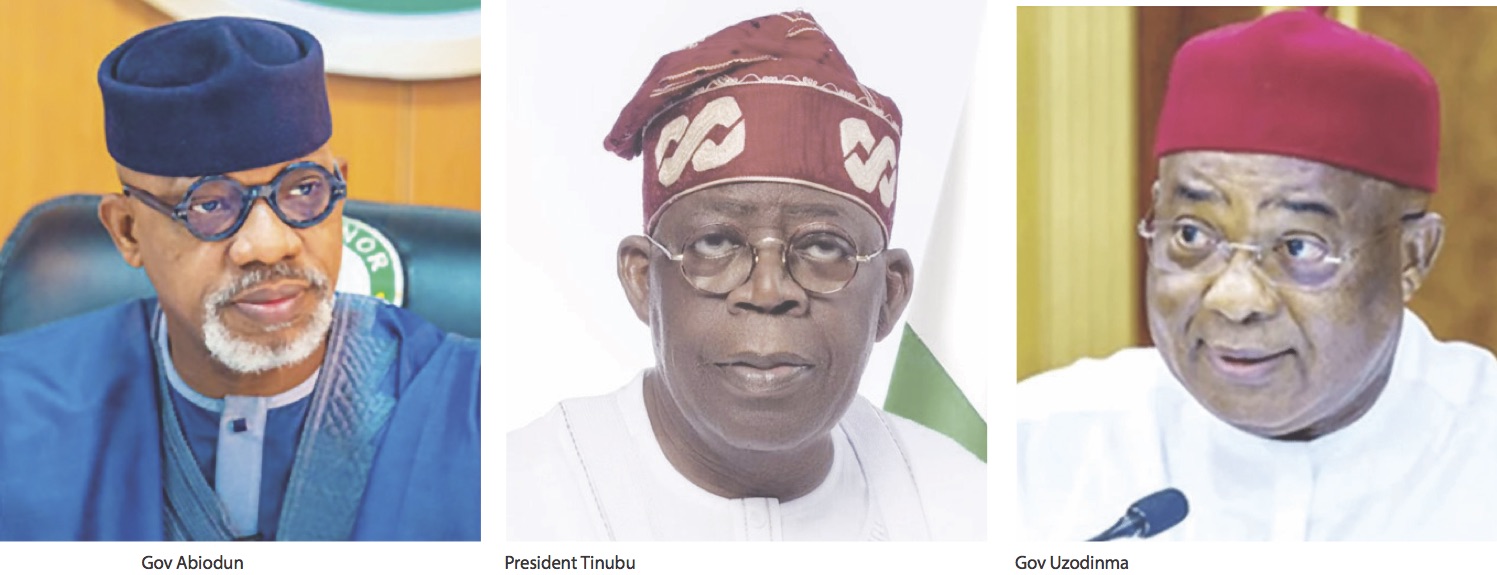
The Progressive Governors Forum (PGF), which ought to be the most cohesive instrument of APC electoral mobilisation ahead of 2027, has been convulsed by a crisis that cuts to the very heart of how power is being managed within the ruling party. The attempted overnight removal of Governor Hope Uzodinma as PGF Chairman, orchestrated by a faction of approximately 20 governors at the Ogun State Governor’s Lodge in Abuja, was not seen as an ordinary squabble over a ceremonial title. For pundits, it was a visible eruption of tensions that have been building steadily beneath the surface of APC unity, tensions rooted in questions of who controls the party, whose ambitions are being served, and whose futures are being sacrificed on the altar of other people’s calculations.
The fact that 18 APC governors subsequently staged a public vote of confidence in Uzodinma, with Kebbi Governor Nasir Idris declaring pointedly that “we do not have any problem,” did not resolve the crisis. For observers, it merely confirmed its depth. When a ruling party’s governors are compelled to hold an emergency solidarity rally to save their forum chairman from removal by colleagues, there is considerably more to what meets the eye.
Wike, Akpabio, Abiodun and the anatomy of a conspiracy
The sources of that fault line are multiple and mutually reinforcing. Nyesom Wike, the Federal Capital Territory (FCT) Minister and former Rivers State Governor, is said to be driving part of the rebellion against Uzodinma, motivated by the Imo Governor’s perceived sympathy for Rivers State Governor Siminalayi Fubara, with whom Wike is engaged in one of the most ferocious political feuds in the contemporary South South. For Wike, the PGF chairmanship is not an abstraction. It is a lever. Control it, and you influence which governors receive party support, which candidates emerge from primaries, and which political futures are advanced or extinguished.
Senate President Godswill Akpabio, also views Uzodinma as a potential rival for the Senate Presidency in 2027, given the Imo Governor’s stated intention to return to the upper chamber before completing his tenure. For Akpabio, a man who has demonstrated throughout his political career that he plays the long game with exceptional patience, the calculation is straightforward: neutralise a potential competitor now, before he arrives at the Senate with the organisational clout of a former PGF chairman behind him.
“Wike wants to punish him for Fubara. Akpabio wants to clip his wings before he gets to the Senate. The Governor of Ogun State wants to reduce his influence because he believes he calls the shots. They found themselves,” a senior party source stated with the kind of bluntness that only anonymity permits.
The convergence of these political giants around the singular objective of removing Uzodinma reveals something important about the character of the crisis. There are no competing visions for Nigeria’s future animating these manoeuvres. The issues revolve entirely around personal power, position and political survival. For many, that is precisely what makes it so dangerous for the APC as a governing institution.
A party at war With its own ticket
Beyond the Uzodinma affair, a deeper structural tension is corroding the party from within. Multiple blocs have emerged inside the PGF, broadly divided along the fault line of those who believe Uzodinma is wielding disproportionate influence over the emergence of governorship and senatorial candidates in APC-controlled states, and those who have acquiesced to his authority.
Simultaneously, the Presidential Villa is reported to be exercising its own parallel influence over the APC National Working Committee, effectively determining who receives tickets and who does not in ways that bypass the forum entirely.
The consequence of this dual power structure is that nobody is entirely certain who speaks for the party, whose endorsement actually matters, or which calculations will ultimately determine outcomes at the primaries. The human cost of this confusion is already visible in specific contests across the country. In Ogun State, Governor Dapo Abiodun’s reported senatorial ambitions risk a bruising collision with sitting Senator Gbenga Daniel, himself a former governor with deep roots and a network that does not bend easily.
In Gombe, Governor Muhammadu Inuwa Yahaya’s designs on a senatorial seat point directly at the constituency long held by former Governor Danjuma Goje, a man not known for graceful surrender. In Imo State, Uzodinma’s own Senate ambitions threaten to displace Senator Osita Izunaso, even whilst Uzodinma simultaneously serves as the very chairman charged with coordinating orderly party processes. The irony is not lost on those watching.
Other News
Serving governors are being denied tickets to contest Senate seats. Former governors who anticipated smooth transitions to the Red Chamber are finding their paths blocked by invisible forces operating out of Abuja. Senators who served loyally through the 10th Assembly are discovering that loyalty purchases no guarantees in a party where the rules of engagement shift with each passing season. The disillusionment is palpable and spreading, and disillusionment in Nigerian politics has a well-documented tendency to transform itself into defection at the worst possible moment.
History repeating, lesson unlearned
This is, again, recognisably the pathology that consumed the PDP. Like the PDP before it, the ruling party’s internal processes have become opaque, with ticket allocation now perceived as the personal prerogative of a small cabal rather than the product of transparent democratic competition. Aspirants who lose out do not accept defeat and go home. They organise. They defect. They sabotage. They become, in electoral terms, the opposition’s most valuable assets. The APC was itself built, in no small measure, from the wreckage of PDP governors and stalwarts who felt marginalised by Jonathan’s inner circle. Tinubu’s team, which ought to know this better than anyone because they lived it and exploited it masterfully in 2015, has become its own biggest problem.
President Tinubu came to power on the strength of one of the most sophisticated political coalition-building exercises in Nigerian democratic history. His victory in 2023 was birthed through the simultaneous management of regional sensitivities, religious anxieties, ethnic calculations and the competing ambitions of dozens of powerful political figures. That he is now presiding over a party in which his own governors cannot hold a forum meeting without it degenerating into a factional battle raises a serious and uncomfortable question: has the coalition that brought him to power already begun to consume itself?
Economy, hardship and the cost of distraction
The economic context compounds the political danger considerably. Nigerians are living through one of the most punishing periods of economic hardship in a generation. Inflation has eroded purchasing power across every social stratum. Food insecurity has reached crisis proportions in multiple states. The reforms that the Tinubu administration argues are necessary for long-term stabilisation have imposed short-term costs of extraordinary severity on ordinary citizens who queue for petrol, calculate whether they can afford to feed their families and watch their savings dissolve in the heat of unrelenting inflation.
In this environment, a ruling party that presents itself to the electorate as fractured, self-absorbed and more preoccupied with internal power struggles than with the welfare of the governed is not merely vulnerable. It is offering the opposition a gift of incalculable value.
Jonathan’s tragedy was partly that his government’s economic management became the backdrop against which his party’s internal chaos played out, making it impossible to separate policy failures from political dysfunction in the public mind. Voters who might have been persuaded to focus on one or the other found themselves confronted by both simultaneously.
The APC is now in danger of creating exactly the same compound narrative: a party whose economic stewardship is already fiercely contested, now visibly at war with itself over the spoils of power.
The South East signal and the silence of APC governors
The marginalisation of Uzodinma carries an additional dimension that deserves serious attention. As one of the most prominent political figures from the South East, his diminishment within the party structure sends a signal to Igbo voters that the APC has neither the intention nor the capacity to genuinely integrate their interests into its governing coalition. The South East has historically been the most resistant region to APC penetration, and the Tinubu administration has invested considerable effort in changing that calculus.
A conspicuous internal battle that results in the humiliation of the region’s most senior APC figure would undo much of that work in a single stroke, potentially driving South-east votes towards whichever platform successfully positions itself as the authentic voice of Igbo political aspirations in 2027.
The governors who declined to join the vote of confidence in Uzodinma are considered the most politically consequential figures in the current drama. In the language of Nigerian politics, declining to publicly affirm a colleague under pressure is a statement of intent. It signals that the rebellion is not spent, that the structural grievances animating it remain unresolved, and that the next eruption is a matter of when rather than whether. Each of those governors carries a constituency, a network and a capacity for disruption that the party cannot afford to dismiss.
An opposition sharpening its knives
The opposition, it must be said, is watching all of this with barely concealed appetite. The PDP, battered and directionless since 2023, has been handed an unexpected opportunity to regroup around the narrative of APC dysfunction. More significantly, the Nigeria Democratic Congress, the new political vehicle attracting considerable attention from disaffected political figures, could be energised enormously by a wave of APC defectors carrying gubernatorial networks, senatorial ambitions and deep grievances into its ranks. A ruling party haemorrhaging its own powerful stakeholders does not merely weaken itself. It actively builds its opponents.
The choice before Tinubu
What, then, is to be done? The historical record suggests that ruling parties facing this kind of internal fragmentation have two broad options. The first is genuine reconciliation, which requires the centre to make credible and verifiable concessions to aggrieved factions. This means the Presidential Villa stepping back from its reported micromanagement of the NWC, allowing the PGF to function as a genuinely consultative body rather than a rubber stamp for decisions already made in Aso Rock, and establishing clear and enforceable rules for primary elections that protect sitting lawmakers from arbitrary displacement. It means creating a framework within which the ticket aspirations of outgoing governors can be managed without triggering open warfare with incumbent senators. It means, in short, treating the party as a coalition of interests that must be collectively sustained rather than a personal instrument to be wielded.
The second option is suppression, using the instruments of state power and patronage to silence dissent and force compliance. Suppression tends to work in the short term and catastrophically in the medium term, because those suppressed do not disappear. They wait, they organise and they strike at the moment of maximum electoral vulnerability, which is precisely what the campaign season ahead will represent.
Jonathan chose suppression and lost. The APC, watching from the opposition benches in 2015, understood exactly what had gone wrong and crafted its strategy accordingly. A decade later, the party appears to be repeating the same error with the same confidence that this time, for reasons never quite articulated, the outcome will somehow be different. That confidence is perhaps the most dangerous element of the current situation. It suggests that the lessons of history have been absorbed intellectually but not emotionally, understood as a story about other people rather than as a warning addressed directly to those now holding power.
A warning the APC cannot afford to ignore
Nigeria’s political landscape has changed considerably since 2015. The electorate is younger, more urban, more digitally connected and demonstrably less loyal to party labels than any previous generation. The 2023 election, in which Peter Obi’s Labour Party disrupted the traditional two-party calculus and captured millions of votes on the strength of sheer disillusionment with the established parties, was a warning that the APC has not taken seriously enough. If the party enters the 2027 election cycle visibly fractured, with aggrieved governors, displaced senators and marginalised regional blocs seeking accommodation elsewhere, the beneficiary will not necessarily be the PDP. It may well be the NDC or another platform that neither party currently takes seriously enough, fed by exactly the kind of defection wave that the APC itself rode to power in 2015.
The APC’s house is not yet on fire. But the smoke is visible, the foundations are cracking, and the men responsible for maintaining the structure are too busy fighting over the furniture to notice. Genuine reconciliation remains possible, but the window is narrowing with every leaked meeting, every withheld ticket and every governor who sits on his hands when solidarity is called for. History, as Jonathan’s ghost might whisper, does not announce itself before it repeats. It simply arrives, and by then, it is always too late to be surprised.