Follow Us on Google

By Noah Ebije, Kaduna
The All Progressives Congress (APC) opened its presidential campaign in Kaduna with an impressive display of political strength. Beneath the colourful spectacle, however, lay difficult questions about economic hardship, security, governance and the party’s ability to turn a massive rally into votes in January 2027.
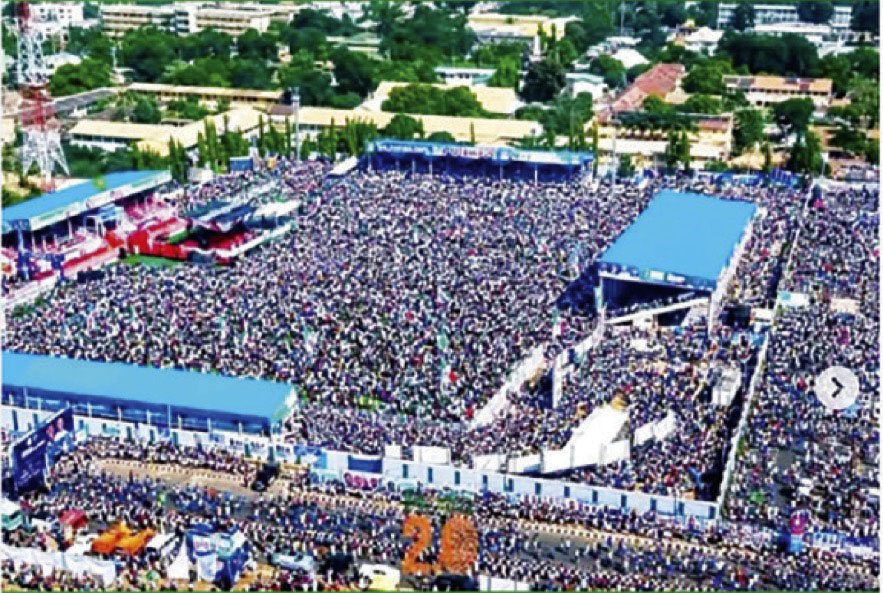
From the early hours of Saturday, October 24, 2026, Kaduna took on the atmosphere of a city at the centre of a defining political moment. Party colours dominated the streets, campaign banners fluttered in the air, music echoed around the venue, and thousands of supporters converged on the Kaduna Township Stadium, also known as Ranchers Bees Stadium, for the official flag off of the APC presidential campaign ahead of the 2027 general election.
For the ruling party, the occasion was more than a ceremonial beginning to President Bola Ahmed Tinubu’s bid for a second term. It was an opportunity to demonstrate organisational capacity, consolidate its northern political base and persuade Nigerians that the administration deserves another four years.
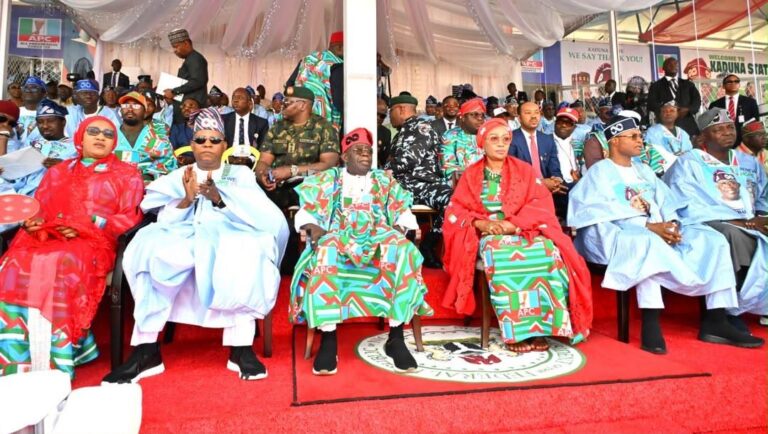
The arrival of President Tinubu, accompanied by Vice President Kashim Shettima and welcomed by Kaduna State Governor Uba Sani and other party leaders, provided the defining moment of the gathering. Supporters responded with cheers, songs and chants, turning the stadium and its surroundings into a sea of political enthusiasm.
Yet beneath the celebratory atmosphere was a more complicated story. The rally gave the APC an opportunity to showcase its political machinery and advertise the achievements of the Tinubu administration. At the same time, it exposed the challenges of managing a large political gathering and the difficult economic realities against which the President’s campaign will be judged. The gains were visible. So, too, were the pains.
The decision to launch the APC’s presidential campaign in Kaduna was politically significant.
As one of the North’s most important political centres, Kaduna occupies a strategic position in Nigeria’s electoral calculations. Its diverse population, geographical location and links to neighbouring states make it a natural meeting point for political mobilisation across the North West and beyond.
The presence of party leaders, governors, ministers, legislators and supporters from different parts of the country gave the gathering the character of a national political convention.
For the APC, the rally offered a chance to communicate unity within its ranks and project confidence ahead of a presidential contest that promises to test the party’s popularity.
The turnout also gave the ruling party a platform to energise its grassroots structures and encourage supporters to begin the long process of voter mobilisation.
However, political analysts noted that rallies are not elections. A stadium filled with enthusiastic supporters does not automatically translate into millions of votes at the ballot box.
The real test for the APC will be whether the enthusiasm displayed in Kaduna can be sustained through ward level mobilisation, voter registration where necessary, issue based campaigning and effective engagement with Nigerians whose choices will depend on their personal experiences of governance.
The crowd was an important political statement. Whether it becomes an electoral advantage remains to be seen.
One of the most immediate gains for the APC was the opportunity to demonstrate its organisational reach.
The presence of prominent party figures and supporters from across the country reinforced the impression that the ruling party has a formidable political network behind its presidential candidate.
For President Tinubu, the rally provided an opportunity to present his administration’s record, defend its policies and appeal for another mandate.
The President urged Nigerians to support his bid for a second term, promising continued efforts towards economic recovery, prosperity and a better future for young people.
His message was built around continuity: the argument that the policies introduced by his administration need more time to produce the desired results.
The campaign’s central challenge, however, is to convince voters that the anticipated benefits of these policies will be felt in their homes, workplaces, farms, businesses and communities.
For many Nigerians, economic statistics and government announcements matter most when they translate into affordable food, lower transport costs, reliable electricity, decent employment and improved purchasing power.
Consequently, the APC’s campaign will need to move beyond broad assurances and explain how its policies will improve everyday life. Infrastructure featured prominently in the arguments advanced by APC leaders at the rally.
Governor Uba Sani highlighted federal government interventions in transportation, education, healthcare, agriculture, security and human capital development. He presented them as evidence of the benefits of cooperation between the Federal Government and Kaduna State.
Among the projects he cited was the reconstruction of the 123 kilometre Kaduna to Birnin Gwari road, which he said had received substantial funding after years of abandonment.
He also pointed to the Abuja, Kaduna and Kano road project, the Zaria to Soba road corridor and a proposed metropolitan rail project for Kaduna.
These projects, if completed to the required standards and made accessible to the public, could deliver significant economic benefits. Improved roads can reduce travel time, ease the movement of agricultural produce, connect businesses to markets and improve access to essential services.
For communities that have endured years of poor road infrastructure and insecurity, such improvements could be particularly consequential.
Nevertheless, campaign claims about project funding and completion must be distinguished from independently verified delivery. The ultimate measure of success is not the amount announced or released, but the quality of the infrastructure, the proportion completed, the time taken to deliver it and the benefits citizens actually experience.
The APC’s challenge is to turn these projects into a convincing record of public service. Security was another important theme at the Kaduna rally. The North West has experienced prolonged challenges involving banditry, kidnapping and attacks on rural communities. These problems have disrupted farming, displaced residents, threatened livelihoods and undermined confidence in public institutions.
Governor Sani argued that security had improved along the Birnin Gwari corridor. He cited the reopening of schools and primary healthcare centres that were previously closed because of insecurity.
If sustained, such improvements would represent meaningful progress for the affected communities.
The reopening of schools restores opportunities for children whose education had been interrupted. The return of healthcare services improves access to treatment, maternal care and other essential services. Safer roads also make it easier for farmers and traders to move between communities.
However, security gains must be assessed through the experiences of residents across the affected local government areas, not simply through political declarations.
Communities need lasting protection, freedom from kidnapping, safe access to farms and markets, and confidence that improvements will endure beyond the campaign season.
For the APC, the security question is both an opportunity and a test. It is an opportunity to demonstrate progress, and a test of whether that progress is broad and sustainable enough to reassure voters.
The rally also served an important internal political purpose. By bringing together governors, legislators, ministers and party officials, the APC created an opportunity to reinforce relationships among its political stakeholders and signal readiness for the election ahead.
Such gatherings can help coordinate campaign messaging, strengthen mobilisation networks and encourage party members to work towards a common objective.
The choice of Kaduna also allowed the party to focus attention on a region that will be central to the presidential contest.
However, the North is politically diverse, and its voters cannot be treated as a single bloc. Economic conditions, security experiences, local political relationships, religious and ethnic diversity, and individual assessments of candidates all influence electoral decisions.
According to a political observer, the APC must therefore build support through sustained engagement, rather than assume that the size of the Kaduna crowd represents the political preferences of the entire region.
For all its political advantages, the rally was not without difficulties. Perhaps the most revealing images from the event were not confined to the speeches delivered on the platform. They included supporters who arrived early, those who spent the night at the venue and those who endured long hours in the hope of seeing the President.
Reports from the gathering indicated that some supporters arrived as early as the morning hours, while others spent Friday night at or around the stadium to secure entry.
As the crowd swelled, access became increasingly difficult. Earlier reports said supporters waited for hours, and some became frustrated and left after inadequate provision of food and drinks left them hungry and tired.
The President reportedly arrived at the stadium at about 3pm, later than many supporters had hoped. For those who travelled from distant communities, the experience raised practical questions about crowd management, welfare arrangements and the responsibility of campaign organisers towards the people whose presence gives political rallies their significance.
It was also gathered that many party supporters from the far North turned their vehicles and available spaces around the popular Murtala Mohammed Square into places to spend the night.
A social commentator noted that a successful rally should not be measured exclusively by the number of people in attendance or the enthusiasm of the crowd. It should also be judged by how safely, efficiently and humanely the gathering was organised.
Supporters who spent hours in the sun, struggled to gain entry or went without basic provisions may remain loyal to their party, but their discomfort is a reminder that political participation carries responsibilities for those who organise mass events.
The large turnout also put pressure on movement around the city. Major roads and access routes around the venue experienced restrictions and congestion as security agencies managed the influx of supporters, vehicles and dignitaries.
While such measures are often necessary for events involving senior public officials, they can disrupt the daily activities of residents who have no direct involvement in the political gathering. For traders, commuters, transport operators and people trying to reach workplaces or hospitals, prolonged road closures can mean lost time, additional costs and missed opportunities.
The economic impact of a major political rally is therefore not limited to its organisers and participants. It also affects the surrounding population, whose needs should be considered in traffic planning, public communication and emergency access arrangements.
A campaign that seeks a popular mandate must recognise that public spaces belong to all citizens, including those who do not share the political preferences of the organisers.
The most significant challenge facing the APC, however, extends beyond the logistics of the Kaduna rally. It lies in the economic circumstances confronting millions of Nigerians.
President Tinubu’s administration has defended its economic reforms as necessary steps towards stabilising public finances, improving foreign exchange conditions and creating the foundation for long term growth.
The removal of the petrol subsidy and changes in foreign exchange policy have formed major parts of this reform programme.
Supporters of the administration argue that these measures were intended to address longstanding structural problems and improve the country’s economic prospects. But the immediate effects have been painful for many households and businesses.
Higher petrol prices have increased transport costs and put pressure on the cost of moving goods. Currency depreciation has made many imported products more expensive. Rising living expenses have strained household budgets, while small businesses have struggled with operating costs and uncertain consumer demand.
These pressures complicate the President’s campaign for a second term.
At a rally, supporters may celebrate a candidate’s promises and achievements.
At home, however, they must confront the cost of food, school fees, rent, healthcare and transportation. For families whose incomes have failed to keep pace with expenses, the promise of future prosperity may be less persuasive than the need for immediate relief.
This is the central contradiction confronting the APC. The administration can point to economic reforms and improving macroeconomic indicators, but voters will also judge it by whether their material circumstances have improved.
The campaign must therefore answer a difficult question: how soon will the benefits of economic reform become tangible for ordinary Nigerians? Without a convincing answer, the party risks allowing the cost of living to overshadow its other achievements.
Young people were an important part of the political audience at the Kaduna rally, and their expectations will be central to the 2027 election. Nigeria’s youthful population represents an enormous source of energy, innovation and economic potential. Yet many young Nigerians continue to face unemployment, underemployment, limited access to affordable education and difficulties in establishing sustainable businesses.
The administration has promoted initiatives intended to expand access to education financing, vocational training and economic opportunities. At the rally, Governor Sani cited student loan and skills development interventions as examples of programmes meant to support young people in the North West.
Such initiatives can make a difference when they are adequately funded, accessible to eligible beneficiaries and connected to real opportunities in the labour market.
But young voters will want more than programme announcements. They will want evidence that education leads to employment, that skills lead to income and that entrepreneurship is possible without prohibitive financial and infrastructure barriers.
The APC’s campaign must demonstrate how its next phase of governance will expand opportunities for young people and help them participate meaningfully in the economy.
For this group, the success of the campaign may depend less on the spectacle of the rally than on the credibility of the promises made. Another challenge facing the APC is the danger of mistaking visible enthusiasm for guaranteed electoral success.
Political rallies are designed to generate excitement, project strength and communicate momentum. Their organisers typically assemble supporters who already identify with the party or candidate.
Elections, however, involve a wider electorate, including undecided voters, dissatisfied supporters and citizens who may not attend political events but will cast their ballots.
The opposition will seek to exploit concerns about economic hardship, insecurity and the administration’s performance. Its success will depend partly on its ability to present credible alternatives and persuade voters that it can address the problems confronting the country.
For the APC, the challenge is to defend its record without dismissing legitimate public grievances. The political significance of the Kaduna rally should therefore be understood as an opening statement rather than a verdict on the election.
The party has demonstrated that it can mobilise supporters on a large scale. Whether it can persuade a broader electorate is a separate question. The Kaduna flag off offers a useful lens through which to examine the competing forces that may shape the 2027 presidential election.
On one side is the APC’s institutional advantage as the ruling party, its nationwide political structures, its network of elected officials and its ability to present ongoing government projects as evidence of performance.
On the other side are the daily pressures confronting citizens, including the cost of living, insecurity, unemployment and the demand for better public services.
These forces will interact throughout the campaign.
The ruling party will seek to persuade Nigerians that economic reforms require continuity, that infrastructure investments will yield long term benefits and that its security efforts deserve more time.
Its opponents will likely argue that the hardships experienced by many households are evidence that the administration has not delivered enough relief.
Voters will have to weigh these competing arguments against their personal experiences and expectations for the future. For Kaduna State, the rally also presents an opportunity to assess the relationship between political promises and public outcomes.
Roads, rail projects, schools, healthcare facilities and security interventions are important, but their value ultimately lies in whether they improve people’s lives. The same principle applies to national economic policy. Better fiscal indicators matter, but their significance must be reflected in improved living standards, greater employment opportunities and a more secure environment for citizens.
Ultimately, the APC’s political strength will be measured not only by its capacity to organise a massive rally, but also by its ability to make a credible case for continued public support.
The APC’s presidential campaign flag off in Kaduna was an unmistakable demonstration of political organisation and mobilisation. It brought together influential party leaders, attracted supporters from different parts of the country and gave President Tinubu a platform to launch his appeal for a second term.
The occasion also drew attention to infrastructure projects, security interventions, education programmes and other initiatives that the party believes can strengthen its electoral prospects.
Yet the event revealed a less comfortable reality.
The struggles experienced by some attendees, the disruption to movement around the venue and, above all, the economic difficulties confronting millions of Nigerians are reminders that political spectacle cannot substitute for effective governance.
For the APC, the gains of Kaduna will count only if the enthusiasm displayed at the rally translates into sustained grassroots engagement and a convincing argument for continuity.
The pains will remain politically significant if the administration fails to demonstrate measurable improvements in the lives of ordinary Nigerians. As the road to the 2027 election unfolds, the decisive question will not be how loudly supporters cheered in Kaduna or how many people filled the stadium.
It will be whether Nigerians believe that another four years under President Tinubu offer a credible path towards greater prosperity, improved security and a better quality of life. The rally has raised the curtain on the campaign. The electorate will determine how the story ends.