Follow Us on Google
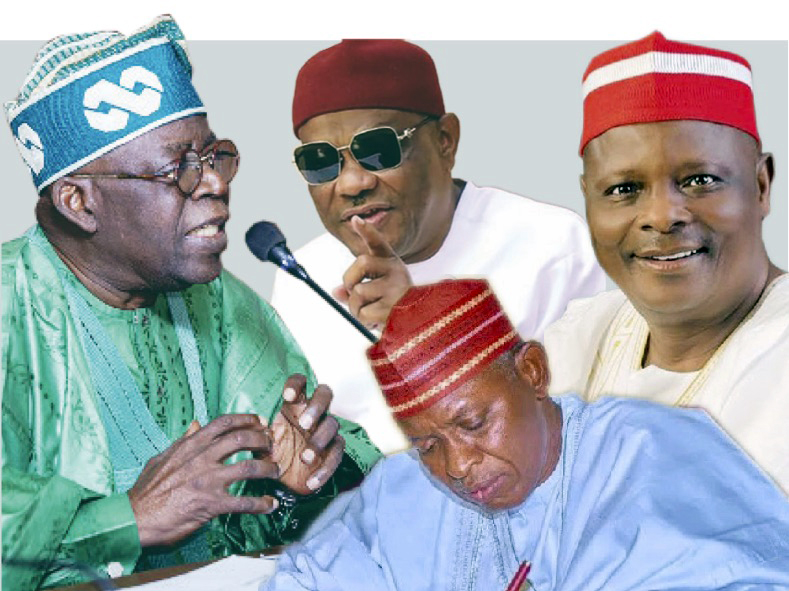
•How battle for Kano, Delta, Bayelsa, others may decide next poll
•Analysts say poached structures may not guarantee grassroots votes
______________________________________________________________________________
By Omoniyi Salaudeen (Lagos), Desmond Mgboh (Kano), Femi Folaranmi (Yenagoa), Tony John, (Port Harcourt) and Isaac John (Uyo)
According to the schedule of the Independent National Electoral Commission (INEC), electioneering for the 2027 general election commences on August 19.
With official campaigns set to begin, the ruling All Progressives Congress (APC) is in overdrive, systematically poaching key opposition figures to supercharge its electoral base across the country. This is not an unfamiliar story. The APC has been quietly building momentum for years, but as the general elections draw closer, its political harvesting has aggressively intensified. Driven by a relentless wave of high-profile defections, the ruling party’s executive dominance across the federation has expanded dramatically, growing from 21 state governors in 2023 to a formidable 31 state chief executives today.

The payoff of this strategy is already starkly visible both in state capitals and inside the corridors of power in Abuja. In the National Assembly, the APC’s ranks have swelled to a commanding supermajority of 88 senators and 261 members of the House of Representatives. Its biggest electoral prize, however, came in the strategic northern hub of Kano. Long regarded as an impenetrable stronghold of the opposition New Nigeria Peoples Party (NNPP), the state’s political map was turned upside down following a massive wave of high-profile defections in January. That structural shift left the APC in firm control of 19 House of Representatives seats and two Senate seats in the state, severely undermining the opposition’s regional stronghold.
Backlash and constitutional concerns
Yet, this aggressive expansion comes with political backlash and constitutional concerns. Opposition leaders and civil society groups have fiercely criticised the trend, labelling it political harvesting, a calculated, desperate manoeuvre to lock up the 2027 election well before official campaigns even kick off. Critics argue that with such overwhelming, unchecked numbers in both chambers of the legislature, the National Assembly faces the dangerous risk of becoming a mere rubber-stamp extension of the executive arm rather than an independent check on presidential power.
Meanwhile, back in Kano, disgruntled NNPP leaders insist that the high-profile defections were engineered through state coercion and politically motivated inducements, arguing that the party switches fail to reflect the genuine political will of the electorate. For this upcoming general election, the structural implications are undeniable. Commanding 31 state houses alongside a dominating supermajority in the National Assembly positions the APC to effectively dictate the operational pace of the election, influencing everything from party candidate nominations down to Election Day state-level logistics.
However, the ruling party faces an inherent, historical risk: sheer numbers and defected elites do not automatically guarantee grassroots voter turnout. In historically volatile political battlegrounds like Kano, where voter sentiment is fiercely independent and can pivot rapidly, a top-heavy strategy of acquiring politicians rather than winning over citizens could easily backfire when real votes are cast at the ballot box.
Why Kano is the ultimate battleground
In political warfare, an army’s strength relies as much on its field commanders as on the passion of its foot soldiers. For Rabiu Musa Kwankwaso, the undisputed leader of the Kwankwasiyya movement, the battle lines for Kano State ahead of the 2027 general elections are being drawn around an unsettling question: can a political general retain his territory if his parliamentary rank-and-file continues to cross enemy lines? The answer is in the womb of time.
However, the Nigeria Democratic Congress (NDC) in Kano State maintains it is entirely unfazed by Senator Rufai Hanga’s planned defection. Party leaders view Hanga’s tenure in the Senate as unimpressive, noting that his prolonged ill health in recent years severely limited his legislative contributions. Consequently, the NDC remains confident that Nasiru Gawuna, the former Kano State Deputy Governor who was handed the party’s ticket, will deliver a far stronger performance at the polls in 2027.
Currently, the political landscape in Kano State remains evenly balanced between the All Progressives Congress (APC) and the NDC. The APC is led locally by Governor Abba Kabir Yusuf under the strategic direction of President Bola Ahmed Tinubu, while the NDC is anchored by Senator Rabiu Musa Kwankwaso. Despite official party alignments, a significant cross-section of ordinary voters remains fiercely loyal to Kwankwaso. Under the present circumstances, President Tinubu continues to face popularity hurdles in the state due to widespread economic hardship and the perception that his administration disproportionately favours the South-West. While elites handling “Renewed Hope” projects appear to be benefiting, the majority of the poor feel increasingly left behind.
At the same time, Kwankwaso faces his own strategic obstacles in convincing core Northern voters to back Peter Obi, a Southern Christian, as a presidential option. The historical regional divide between the South-East and the core North remains a formidable factor in Kano politics.
The fresh political realignments in Kano, highlighted by Senator Rufai Hanga’s consultations across Kano Central to align with the APC, underscore a calculated strategy to dismantle the opposition’s legislative structure. Hanga, alongside an increasing number of federal lawmakers who rode the NNPP’s red-cap wave into the 10th National Assembly, now finds himself at the centre of an aggressive recruitment drive engineered by the ruling party’s top hierarchy. For the APC, the objective is to isolate the Kwankwasiyya leadership at the national level, strip the movement of its legislative leverage in Abuja, and lay the groundwork to reclaim Nigeria’s most prized electoral battleground. If this exodus of lawmakers continues unchecked, Kwankwaso risks heading into the next presidential cycle like a battle-tested General left with an ardent army on the ground, but very few officers to execute his command in the halls of power.
However, while party tickets and political survival drive lawmakers toward the APC’s platform, the crucial test remains whether the voters who lined up behind the red cap will follow their representatives, or treat their departures as desertion. The potential defection of Senator Rufai Hanga is driven by personal disagreement over his Kano Central return ticket. So, his decision to align with the APC represents the latest dividend of a high-stakes, federal-backed campaign designed to dismantle the opposition’s legislative structure in Kano ahead of 2027.
Kano Central is the ultimate prize. Of Kano’s three senatorial districts, Kano Central is indisputably the crown jewel. Housing 15 local government areas, including the metropolis’s commercial core and highest voter-density wards, Kano Central historically dictates the overall direction of state-wide election results. Losing Senator Hanga to the APC fold does more than just tilt a vote in the Senate chamber; it breaks the Kwankwasiyya movement’s legislative command structure right in its metropolitan epicentre. When a senatorial district of that magnitude slips away from an opposition party, it opens structural breaches in grassroots campaign organisation, patronage networks, and ward-level mobilisation. While Senator Hanga continues to publicly dispel rumours of his defection, his recent Villa visit to President Bola Tinubu alongside former Senator Kabiru Gaya, facilitated directly by Deputy Senate President Barau Jibrin, tells the true, unvarnished story.
In Nigerian political power dynamics, a high-level Villa meeting facilitated by the Senate’s second-in-command is rarely a routine courtesy call; it is the classic precursor to a formal party realignment. Hanga’s public denials serve merely to manage immediate legislative optics and protect his position as Deputy Minority Whip until the political groundwork is fully laid. Following his fallout with the NDC leadership over consensus tickets for 2027, Hanga’s engagement with President Tinubu and APC National Chairman Nentawe Yilwatda reflects a familiar survival strategy. For the APC, securing Kano Central’s sitting senator, coupled with Barau Jibrin’s expanding influence in Kano North, is a prized manoeuvre to dismantle the opposition’s remaining strongholds in the state. Whether the formal announcement comes tomorrow or after further consultations with his local coordinators, the Villa visit confirms that the APC’s political harvesting in Kano is far from over — and the formal shift is now a matter of when, not if.
By absorbing key legislative figures across Kano Central and beyond, the party aims to demoralise the opposition, starve its campaign structure of federal patronage, and establish an unbroken chain of command leading into the next presidential cycle. Yet Kwankwaso’s movement continues to rely on direct engagement with community leaders, trade associations, and youth networks across Kano’s 44 local government areas to maintain its electoral defence. If Kwankwaso can retain the loyalty of the ordinary voter, the loss of lawmakers may matter very little when the polls open. Some analysts say Senator Rufai Hanga’s potential defection may leave Rabiu Musa Kwankwaso with fewer parliamentary commanders in the legislative chambers. But as long as the red-capped rank-and-file remains intact on the streets of Kano, the battle for the heart of Northern Nigeria’s political capital remains wide open.
The internal rift among Kano APC chieftains escalated significantly during recent party primaries and the selection process for the vacant deputy governor’s seat. During these consultations, rival factions actively undermined one another, with several key players alleging betrayal by former allies. For instance, Deputy Senate President Barau Jibrin nearly lost his ticket following concerted opposition from former Minister of State for Housing T. Gwarzo, House Appropriations Committee Chairman Abubakar Bichi, and party godfather Dr Abdullahi Umar Ganduje, securing it only after direct intervention from the Presidency.
Similarly, in Kano Central, former Governor Mallam Ibrahim Shekarau was handed the ticket overnight at the expense of A.A. Zaura, who had spent years cultivating local support for the nomination. Parallel bitterness plagues Kano South, where Senator Kawu Sumaila and House of Representatives member Hon. Rirum remain in sharp opposition. Compounding these factional fights is growing disaffection among legacy APC members, who argue that Governor Yusuf has failed to carry them along in executive appointments and patronage distribution. Insiders dismiss recent public displays of unity as mere “camera reconciliations,” warning that unresolved grievances could trigger widespread anti-party sabotage in 2027.
Other News
It is very doubtful if incumbency will offer an automatic path to victory in Kano’s 2027 contests because the ruling party membership alone cannot determine the outcome. Besides, many legislators who were originally elected on the coattails of Kwankwaso’s popularity have failed to build independent political structures capable of guaranteeing re-election. Furthermore, several lawmakers who were subtly pressured into defecting to the ruling APC severed ties with significant portions of their core base in the process, severely weakening their standing ahead of 2027. Overall, both leading political parties are expected to split victories across state and federal legislative seats.
Other concerned states
The APC’s poaching in Kano is neither an isolated case nor a new strategy. It is the continuation of overtures that culminated in the mass defection of National Assembly members and state governors. Since 2023, nine sitting governors have crossed to the APC, from Sheriff Oborevwori in Delta and Umo Eno in Akwa Ibom, to Peter Mbah in Enugu, Douye Diri in Bayelsa, Siminalayi Fubara in Rivers, and Abba Yusuf in Kano. Others are Agbu Kefas (Taraba State), Caleb Mutfwang (Plateau State), and lately Umaru Fintiri (Adamawa State). That wave alone has expanded APC’s state control from 21 to 31.
In Abuja, the numbers are just as stark. When the 10th Assembly was inaugurated in June 2023, the APC had 59 senators and 175 representatives. Today, it controls 88 senators and 261 representatives, a direct result of sustained defections from the PDP, LP, and NNPP. The strategy is simple: poach sitting governors, and their legislatures will follow.
Akwa Ibom: APC, PDP forge unity for re-election of Gov Eno
Governor Umo Eno’s defection to the APC has created an unprecedented realignment between legacy APC members and the PDP loyalists who crossed over with him. However, underlying friction continues to threaten party cohesion. This hostility surfaced during the recent APC ward, local government, and state congresses, where defecting PDP members reportedly dominated proceedings to claim key party positions, including ward chairmen and secretaries. The situation nearly escalated into a major crisis before Governor Eno and Senate President Godswill Akpabio intervened, brokering a temporary power-sharing agreement between the competing blocs. Despite this compromise, foundational APC members feel deeply side-lined. The PDP faction continues to control key government apparatuses, comprising current commissioners, state House of Assembly members, local government chairmen, councillors, and major stakeholders. Legacy party members complain that after maintaining the APC through lean opposition years, they have been pushed to the perimeter while defectors retain executive authority. Many aggrieved stakeholders warn of an impending political clash between the two factions. They point out that PDP defectors still monopolise Governor Eno’s kitchen cabinet, fearing that if a post-election cabinet reshuffle fails to materialise, cold war tensions could erupt between Governor Eno and Senate President Akpabio.
To soften these internal divisions, Governor Eno introduced the “Akwa Ibom United” banner, bringing APC and PDP chieftains together at official state functions. This initiative has produced unusual political collaborations, such as PDP State Chairman Hon. Aniekan Akpan appearing alongside APC State Chairman Obong Stephen Ntokekpo. The Aniekan Akpan-led PDP operates in alignment with the Nyesom Wike faction backed by Governor Eno, while the caretaker committee led by Barr. Igwat Umoren remains unrecognized within the state. Meanwhile, anti-defection PDP loyalists remain determined to field an opposition candidate to challenge Governor Eno in 2027.
However, core PDP supporters remain sceptical of prospective opposition candidates who continue to maintain close personal and public ties with the governor, viewing the broader coalition as a fragile arrangement unlikely to survive the next election cycle.
Bayelsa: Old vs new member dichotomy poses threat
The APC in Bayelsa State continues to navigate a sharp divide between legacy members and recent defectors following Governor Douye Diri’s transition into the party. At the centre of the dispute are allegations by foundation members, predominantly loyalists of former Governor Timipre Sylva, that incoming defectors have executed a structural takeover. These members argue that Governor Diri’s defection was timed during Sylva’s legal troubles to undermine his political network. They point to recent party primaries, where Sylva associates were systematically denied tickets, as evidence of deliberate marginalisation.
However, party leaders downplay the existence of a systemic crisis, describing the integration process as a work in progress. Speaking at the commissioning of the party’s new “Unity Secretariat,” Governor Diri emphasised that the facility has successfully brought diverse political factions under one roof for the first time in years. Minister of State for Petroleum Resources Senator Heineken Lokpobiri echoed this sentiment, praising Governor Diri’s leadership and expressing confidence that the party will secure victory across Bayelsa in 2027. Similarly, NDDC Managing Director Dr Samuel Ogbuku maintained that the governor’s entry has injected fresh momentum into the state chapter. Addressing party faithful, Governor Diri reassured legacy members that no faction had hijacked the party structure, describing candidates who conceded in the recent primaries as the true heroes of the APC. He urged leaders to use political appointments for community empowerment rather than factional oppression.
However, Sunday Sun findings indicate that while the APC is well-positioned to perform strongly in National Assembly contests, candidates who replaced legacy Sylva allies face significant grassroots resistance in state legislative races, where local dissatisfaction could impact election day outcomes.
Rivers: Three factions, one jersey
In Rivers State today, the APC represents three distinct political tendencies forced into a single jersey, and that internal friction is defining the state’s political trajectory ahead of 2027. The old APC consists of the Chibuike Amaechi and Tonye Cole bloc that built the party in Rivers between 2013 and 2015, surviving years of executive exclusion, fierce legal battles, and anti-party accusations. Although Amaechi eventually defected to the African Democratic Congress (ADC), his loyalists still view themselves as the authentic foundation of the APC. A bitter legal war continues between this faction, led by Emeka Beke, and the faction loyal to the Minister of the Federal Capital Territory (FCT), Nyesom Wike, led by Tony Okocha.
The first major wave of new entrants arrived when the 27 members of the Rivers State House of Assembly, along with their local government area structures loyal to Wike, defected from the Peoples Democratic Party (PDP) to the APC. Although Wike publicly maintains his PDP membership while exercising influence across both parties, political insiders note that the arrival of his allies effectively transferred operational control of the state APC structure from Amaechi’s camp to Wike’s network.
The second major shift occurred when Governor Siminalayi Fubara defected to the APC in late 2025, registering as party member 001. This set off an intense war for structural control. While the APC national leadership declared all defectors and legacy members equal, two parallel structures emerged on the ground: one fiercely loyal to Wike and another attempting to anchor itself around Governor Fubara. This feud spilled over during candidate selections. In the 2025/2026 party primaries, Wike loyalists reportedly swept the APC tickets while Fubara’s allies faced disqualifications and factional screening, sparking accusations of media warfare and political exclusion.
Despite these internal battles, the APC in Rivers is positioned as a formidable political force, driven by Wike’s commitment to delivering a presidential election victory for President Bola Ahmed Tinubu in 2027. The party demonstrated its electoral reach by winning 20 out of 23 local government areas in the August 30, 2025 council polls, leaving the PDP with just three.
Historically, the APC had been weak at the grassroots level in Rivers State. Prior to the feud between Wike and Fubara, Rivers had been a PDP stronghold since 1999, with APC popularity largely driven by political elites rather than ward-level structures. However, Wike’s alignment with the APC and his establishment of a broad multi-party coalition — encompassing PDP, APC, Labour Party, and other political actors to produce consensus candidates — has gradually deepened the party’s presence at the grassroots.
To consolidate this advantage, the APC is conducting an e-registration drive targeting five million members across 6,866 polling units in 319 wards while harmonizing local support groups. As a result, the APC in Rivers is widely recognised as a vehicle for power rather than an ideological choice. Political analysts point out that in key areas like Obio/Akpor, Port Harcourt City, and the Kalabari kingdom, voter loyalty remains attached to individual leaders — Wike, Fubara, or Amaechi — rather than the party’s broom emblem. Whichever faction controls the governorship structure alongside federal backing will be perceived as dominant.
Furthermore, analysts caution that defection in Rivers was inherently top-down. Governor Fubara’s 2025 transition to the APC was driven by a strategic need to align with the federal government to secure state resources rather than a response to a grassroots groundswell. The same applies to the lawmakers whose constituents did not automatically follow them into the APC. In Rivers political culture, voters generally align with a sitting governor or a dominant godfather rather than an assembly member, making individual lawmakers vulnerable if the governor and the FCT Minister remain at odds.
Ultimately, election delivery in Rivers State hinges on who the FCT Minister backs and who controls the local government chairmen and polling unit agents. Whether the three competing factions achieve genuine reconciliation or not, defected lawmakers aligned with Wike’s cross-party coalition remain strongly favoured to win their contests in 2027, unless their leadership decides on a different path.
Criticisms and internal sabotage
Three reasons appear in almost every defection letter: internal party crisis, the need for federal alignment, and early positioning for 2027. Critics argue Nigeria is drifting toward a de facto one-party state. Inside the APC, the risk is different: ticket fights. The question now is whether the APC can turn defections into votes.
As usual, new defectors will expect rewards. Old members will feel pushed aside. That tension is already surfacing in Kano, Delta, Akwa Ibom, and Bayelsa. While the party can poach a governor and federal lawmakers, it cannot automatically poach their voters. If the people see the defections as betrayal, all the structures in the world won’t save the APC on Election Day. Even within the APC, there is unease, prompting Senator Ali Ndume to warn that “some governors defecting to APC have no value to offer” and urging the party to focus on unity behind President Tinubu instead of just expanding numbers.
Ahead of campaigns, the APC has built what looks like an unassailable machine: 31 states, 88 senators, 261 representatives, and party structures now aligned to new governors. Yet power that large creates its own problems. Voter fatigue, internal sabotage over tickets, and accusations of a one-party state could turn the advantage into a liability. The real battleground will be states that switched parties without an election — Kano, Delta, Akwa Ibom, Enugu, Bayelsa, Rivers. Will voters follow their leaders, or reject them? By 2027, Nigerians will know if the APC’s poaching strategy was genius or the reason it lost.