Follow Us on Google

From Godwin Tsa, Abuja
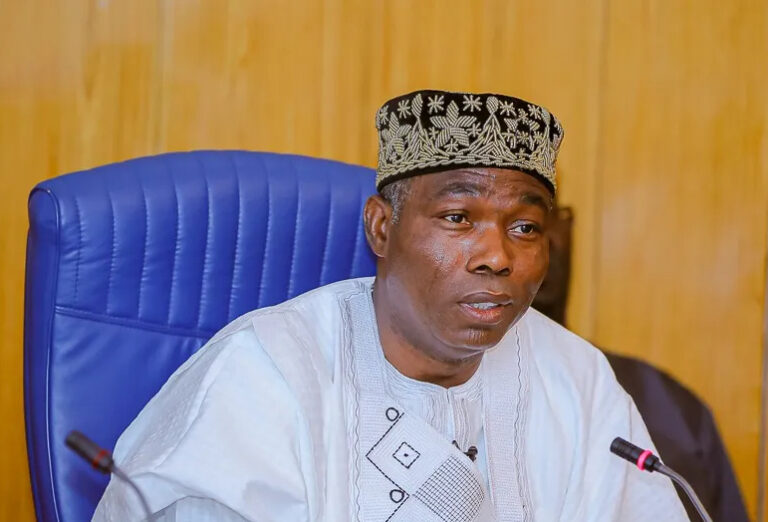
A constitutional lawyer and author, Chief Sabastine Hon (SAN) has faulted the position of Lagos lawyer, Mr. Femi Falana (SAN) calling on the Acting President, Prof. Yemi Osinbajo not to sign the 2017 Budget.
Falana is of the view that the National Assembly acted illegally in increasing the budgetary estimates earlier submitted by the President.
He, therefore, called on the acting president not to append his signature to the budget until the National Assembly removed the N448 billion added to the budget.
But, while disagreeing with Falana, Hon stated that under section 81(1) of the Constitution of the Federal Republic of Nigeria, 1999 (as amended) the president of Nigeria is obligated each year to cause budgetary estimates to be “laid” before each house of the National Assembly.
According to Hon, once that is done, the National Assembly becomes obligated under section 59 of the Constitution to deliberate on the estimates and pass same into law as an appropriation bill.
He argued that the word “laid” in section 81(1) of the Constitution, if read subject to the legislative powers of the National under section 59, has given the National Assembly some level of powers over the estimates sent by the President.
“Indeed, the word “laid” in the subsection suggests about two things: (a) ‘put on the legislative table for deliberation and passing into law;’ and (b) ‘consider the estimates as human beings and not as robots.’ Clearly, from this interpretative reasoning, the National Assembly has power to tinker with the estimates sent to it by the president – and this includes subtracting or adding to those estimates.
If the framers of the Constitution had intended that the president alone should have power over budgetary proposals, they would not have enacted sections 59 and 81(1) of the Constitution. I make bold to state that these are some of the provisions intended by the lawmaker to act as checks and balances in the power sharing arrangements of the Constitution as between the executive and the legislature.
It is not right for a court to read into an enactment an exception which has not been included in such statute and which will have the effect of depriving the person intended to be protected by that provision or statute, vide: Fajimolu vs. University of Ilorin (2007) All FWLR (Pt. 350) 1361 C.A.
Besides, it is a settled principle of statutory interpretation that what is not excluded by the express words of a statute is to be interpreted as being included therein.
The National Assembly is further backed by section 10(2) of the Interpretation Act, 2004, which provides thus: 10(2) An enactment which confers power to do any act shall be construed as also conferring all such other powers as are reasonably necessary to enable that act to be done or are incidental to the doing of it.
Also, the US Center on Budget and Policy Priorities, in a February 17, 2016 publication entitled “Policy Basics: Introduction to the Federal Budget Process,” listed several items on the US budget – like “almost all defense spending,” and “budgets for a broad set of public services, including environmental protection, education, job training, border security, veterans’ healthcare, scientific research, transportation, economic development, some low-income assistance, law enforcement, and international assistance” – as some of the items the US Congress exercises discretion on the amounts to be pegged, in spite of the estimates from the Presidency.
Hon finally submitted that “it will be suicidal now to delay signing into law the 2017 budget, given that we are at the threshold of the 2nd quarter of the year. What we should be encouraging the Osibanjo-led Presidency to do is the implementation of the executive orders it recently passed, one of which has to do with establishing by force of law the timelines for submission of budgetary estimates by government agencies and parastatals.